Showing posts with label New York -- The Adirondacks. Show all posts

Friday, November 8, 2019

A Goose Here, A Goose There Every Day, But Never The Elusive Moose! -- Friday Fotos (November 8, 2019)


In the early 1970s, Molly's parents bought a lakeside Adirondack "camp"[1] out Mt. Whitney Rd. on Lake Placid.  They had the camp for just over three decades.  Our sons went up there every summer from the year each was born until the early 2000s when the camp was donated to Cornell University (where both of Molly's parents attended undergraduate and/or graduate school).

Molly's parents' camp on Lake Placid


The Adirondack Park in upstate New York is a gem of protected nature and wilderness.  It encompasses about a third of New York State's total land mass. [2]  It is unique within the United States.  The Park was created by the state legislature in 1892 and now comprises about 9,375 square miles (six-million acres) of northern woodlands and lakes.  This means the Park is about the size of the state of Vermont and it is three times the size of Yellowstone National Park in Wyoming; in fact it is larger in size than Yellowstone, Everglades, Glacier, and Grand Canyon National Park combined!  The park is a combination of both public and private land and more than half of its land mass is privately owned.  About 45% of the land has been designated as "forever wild" in the New York state constitution.  The private land is committed to 105 towns and villages, farms, businesses, etc.  The year round population in the Park is around 130,000 and another 200,000 seasonal residents arrive in the summer.  About 10 million people visit the Adirondack Park each year and unlike national parks there are no entrance toll booths and no fees for entering the Park.

The Adirondack Park -- especially in the forever wild areas and in areas that have not been over developed with camps -- has a wide variety of wildlife.  Over the years we have seen deer, coyotes, beavers, otters, eagles, black bears, a Great Horned owl, loons, Canada geese, herons, skunks, hawks, and other wildlife too numerous to list here.  But, despite the numerous signs such as the one below warning of moose in the area -- and our constant vigilant eyes when in "moosy areas" -- we never saw a moose in the wild .  .  . until this past August when we visited Molly's sister Kathy who lives in Saranac Lake, NY.

A typical Adirondack roadside sign warning of moose habit ahead


When we arrived in the late afternoon, Kathy announced as soon as we pulled into her driveway that a moose had been sighted numerous times in late afternoon feeding in the shallows on the banks of the Saranc River north of the village.  She had seen it and so we got back into the cars and went off to finally find and see an Adirondack moose.

It is estimated that there are only between 500 and 700 moose in the entire state of New York, but the only population outside the Park is near Lake Desolation south of Great Sacandaga Lake, which is in the southern-most part of the Park.  With that said, sightings of an Adirondack moose are rare and in more than 40 years of trying to see one we failed until this past August!  They are out there, but they are basically very shy and not comfortable near human populations.  Yet, the greatest danger to the moose is collisions with fast-moving vehicles on roads in the Park.  Luckily for us, the five most likely places within the Park to see a moose include the Saranac Lake area (the other four are Vermontville, Limekiln Lake -- Cedar River Road,  and Lake Lila).

We drove slowly up along the Saranac River a couple of times and finally on the last pass Kathy spotted the moose.  We parked and walked back on the shoulder of the road.  I was armed with my digital camera and two telephoto lenses.  Below is the result .  .  . FINALLY!  ðŸ˜ŠðŸ˜Š


Three views of the real Adirondack moose in the wild finally caught on camera

_ _ _ _ _ _ _ _ _ _ _ _ _ _ _ _ _

Copyright 2019, John D. Tew
_ _ _ _ _ _ _ _ _ _ _ _ _ _ _ _ _

[1]   In the Adirondacks a lakeside or woodland cabin is often referred to as a "camp" rather than a cottage or even a cabin.  The so-called "Great Camps" were not the summer camps for children that we most often think of when talking about camps today.  Instead, a Great Camp was a lakeside, grandiose compound of a main residence and associated cabins for guests to sleep in or for other uses.  One Great Camp even had an outdoor bowling alley with a roof and open sides.  The Great Camps were mostly built in the late 1800s and early 1900s as summer homes for the wealthy to enjoy cooler weather, swimming, boating, fishing and other activities in nature's wilderness areas.  [For more info on Great Camps see, https://en.wikipedia.org/wiki/Great_Camps As the lakes and woods of the Adirondacks developed, just as "a man's home became his castle," the later more modest summer homes on a lake or out in the woods became known as a "camp" rather than a cottage or cabin."

[2]  See https://parks.ny.gov/regions/adirondack/default.aspx

_ _ _ _ _ _ _ _ _ _ _ _ _ _ _ _

Wednesday, March 8, 2017

History, Genealogy, and Ice Harvesting


History and Genealogy are conjoined twins, and like all such twins, while they are intimately connected, they each eventually and inevitably develop different perspectives and interests. One has perhaps a broader vision and more desire for external adventures and the other maybe has vision focused in a more limited direction and is content with internal, parochial adventures.  And yet both are inexorably influenced and guided by the other without end.  As I have often thought and said, genealogy is history on the most immediate and personal level, while history writ large is much broader in societal and temporal scope.

Broader history often informs our more personal and focused genealogy endeavors and so I have yet to meet anyone who indulges in Genealogy as a hobby or profession who is not also a devoted student of History. 

And it is with this intimate conjunction of History and Genealogy that I from time-to-time set aside a post here at The Prism to recommend a history book that I think can offer interesting and important material for genealogists. This is one of those posts. 

As a follow up to a recent post about a trip north to the Adirondacks in upstate New York and the Winter Carnival of Saranac Lake, I want to recommend a very interesting and informative book by Caperton Tissot titled "Adirondack Ice a Cultural and Natural History." [1] 


It was not until just after the turn of the last century (in the life time of many of our grandparents) that refrigerators for home use were first invented. Fred W. Wolfe of Fort Wayne, Indiana is often credited as the first inventor in 1913. The early domestic refrigeration systems consisted of a refrigeration unit mounted on a so-called "cold box." These first home refrigeration units were a bit cumbersome and space intensive since most of them required the mechanical parts of the system (the motor and compressor) to be placed in an adjacent room or in the basement while the cold box was conveniently located in the kitchen. It was not until 1923 that the first self-contained home refrigerator unit was introduced by Kelvinator and by that year the company had 80% of the home market for electric refrigerators. But, it was not until 1927 (the year my mother was born) that GE introduced what they called the "Monitor-Top"[2] refrigerator; it became the first really widespread home refrigerator with over 1 million units sold. 

The General Electric "Monitor-Top"
 refrigerator of 1927.

A real downside to the Monitor-Top and similar home refrigeration units was the refrigerants that were used -- either methyl formate or sulfur dioxide. The former was highly flammable and toxic if inhaled or ingested, while the latter was very corrosive and could irritate the eyes and even cause a loss of vision or cause burns and lesions if it came in contact with the skin. It was only when Freon was introduced in the 1930s that a refrigerator with safer, less toxic refrigerant came to market. 

Before powered refrigerators were introduced to American kitchens, the common method of cooling and keeping food in the early 20th-century was a mechanical kitchen appliance known as an "icebox" or "cold closet." [I remember my maternal grandparents still having a beautiful oak ice box in their kitchen in the early 1950s and getting blocks of ice delivered for it.]

An icebox was constructed with walls lined in tin or zinc and packed with insulation made of materials such as cork, sawdust, seaweed, or straw. To provide the cooling, a large block of ice was placed in a compartment of the box or on a tray at the top of the box and then the cold air would circulate down and envelope the lower storage compartments. For less expensive icebox models the water created when the ice block melted would collect in a drip pan that was placed beneath the icebox and would have to be emptied almost every day. More luxurious models had a holding tank for the accumulated ice water and a spigot that could be more conveniently used to drain off the water. 

An oak icebox similar to the one owned by my maternal grandparents.

And with this brief background on refrigeration in American kitchens, we come full circle to Adirondack Ice and how History writ large can so nicely and interestingly inform personal Genealogy.

Iceboxes, of course, were completely dependent on large quantities of ice in order to bring refrigeration into American kitchens. So naturally an industry developed to provide this necessary commodity to American homes. Before the advent of powered refrigeration, it was certainly not feasible to provide the ice for iceboxes through artificial refrigeration and so the source had to be naturally formed ice. And where was the best source for natural, freshwater ice to be found in sufficient quantities? In the large ponds and lakes of the northern tier of American states of course! 

Beginning in the mid-19th century and well into the 1930s the industry known as "ice harvesting" thrived in the United States in order to provide the ice refrigerant necessary for all the iceboxes in kitchens across the country. The basic process involved cutting and retrieving large blocks of ice created naturally in frozen lakes and ponds and preserving them in large, thick-walled ice houses where the blocks were insulated with layers of plentiful sawdust or other materials until they could be transported to market. In the colder climes of the country .  .  .  farms, restaurants, markets, and resorts would construct and fill their own ice houses (or contract with ice harvesters to fill them). In the warmer more southerly states, the ice was transported and stored in ice houses closer to the cities and towns where the ice was needed. [I remember a large ice house up on "the Heights" in Concord, New Hampshire in the early 1960s where my family would get 12 to 18 inch square blocks of ice to use in ice chests for picnics, trips to the drive-in, etc.  The ice was in a building built part way underground with a heavy wooden door that opened into a cavernous, pitch black interior where the blocks of ice would be hauled from under layers of sawdust with tongs and then washed off with a hose before being dropped into our ice chest.] 

So for almost 100 years the natural ice harvesting industry provided a huge number of jobs for Americans from the actual harvesting, to the storage, mass transportation, and delivery of the ice into American homes. At one time the delivery of ice to homes by the "iceman" was as common as the delivery of milk by the milkman and it had all the same social importance. 

Many of us might actually have relatives or ancestors who made their living in whole or in part as integral links in the chain of the ice harvesting industry . . . and this is why I recommend Adirondack Ice as not only a very interesting and informative history, but also as a resource for informing and enhancing an understanding of what could well be a part of your family genealogy!

If you had ancestors or relatives that lived in the northernmost tier of states you might have some ice harvesters in your family tree.  In Adirondack Ice you can learn about the typical process and tools used to get naturally formed ice from frozen lakes. [The tools and terms in the process derive from farming terms and implements and many farmers turned to ice harvesting when their fields were under feet of snow during the intense northern winters.] You might have an iceman in the family who made ice deliveries to homes and restaurants. Or you might have a family member who operated an ice house to supply the iceman, or worked to transport the ice to ice houses from the northern harvesting points.  If any of these occupations are known amongst your ancestors or relatives (or you think they might be), then you really should pick up Adirondack Ice to learn more about this fascinating, but now long-gone industry.

Adirondack Ice is a brief history of the formation and forms of natural ice and a fact-filled, well illustrated explanation of the process of ice harvesting in the past and its limited preservation and uses today.  You can see photographs of the early harvesting process and the development of the tools and automation of the process.  You can see a photo of an ice house in New York that held 46,000 tons of harvested lake ice. Learn how in 1913 -- on the cusp of the powered refrigeration revolution -- 1,200 to 1,500 tons of Adirondack ice, in about fifty train boxcars a day, were shipped to the metropolitan areas of New York City. Learn more about northern ice sports, celebrations, animal strategies for living with ice, and, most of all, learn the importance of northern ice to the way of life of our ancestors and relatives!

Adirondack Ice provides an absorbing connection between History and Genealogy and you will not regret adding it to your reading list -- especially when the heat of summer arrives and you want a nice read while you relax with an ice-filled glass of your favorite drink. 😊      
_ _ _ _ _ _ _ _ _ _ _ _ _ _ _

[1]  Caperton Tissot, Adirondack Ice a Cultural and Natural History (Saranac Lake, New York, Snowy Owl Press, 2010).

[2] Apparently the name "Monitor-Top" came from the resemblance the top unit had to the gun turret on the Civil War era ironclad, USS Monitor.  

The scanned image of the book cover is from this blog author's personal copy of the book.

The image of the GE Monitor-Top refrigerator is from the digital collection of Mike Manning and is used under the Creative Commons Attribution-ShareAlike 3.0 license. https://en.wikipedia.org/wiki/File:Monitor_refer.jpg

The image of an oak icebox similar to one used by my maternal grandparents is from Magi Media and is used under the Creative Commons Attribution-ShareAlike 3.0 license. https://commons.wikimedia.org/wiki/File:Iceboxes.jpg

To learn more about the use of home refrigerators in the U.S. see, https://en.wikipedia.org/wiki/Refrigerator.  For more about "iceboxes" (or "cold closets") see, https://en.wikipedia.org/wiki/Icebox.

_ _ _ _ _ _ _ _ _ _ _ _ _ _ _

Copyright 2017, John D. Tew
_ _ _ _ _ _ _ _ _ _ _ _ _ _ _

Friday, February 24, 2017

The Adirondacks Again -- Winter Carnival 2017


Our trek on a snowshoe trail.


A meadow brook crossing on the snowshoe trail.

I have posted here several times about the special place the Adirondacks have in the hearts and minds of our family. We have been visiting the Adirondacks for over 40 years!  While most of our time over that period has been spent in the High Peaks region of the Adirondacks during the summer, we have been up there during each of the seasons.  

Recently we visited Molly's sister Kathy at her home in Saranac Lake during the "Winter Carnival."  While the temperatures back in northern Virginia were progressively rising into the upper 60s and low 70s (and hit almost 80 degrees F. yesterday), it snowed every day we were in Saranac Lake and did not really get above freezing.  One day it was zero with a wind chill of minus 19! It reminded me very much of my youth in New Hampshire during the late 1950s into the mid-1960s. Snow was everywhere and the community just went on about its business. Stores and restaurants opened without a hitch, the air buzzed with the sound of shoveling, snow plowing, snow blowing, and the excitement of Winter Carnival.

In the 1880s, the village of Saranac Lake was a logging community that was evolving into a location where tuberculosis victims could go to "take the cure" in the fresh air of the Adirondacks. The great grandfather of political cartoonist, Garry Trudeau, was instrumental in putting Saranac Lake on the map for the battle against TB.  A tuberculosis sufferer himself, Dr. Edward Livingston Trudeau founded the Adirondack Cottage Sanitarium in Saranac Lake in 1885 and soon "Cure Cottages" sprang up all over the village.  In 1887, the writer Robert Louis Stevenson was one of the early notables who traveled to Saranac Lake to take the cure.  

The genesis of Winter Carnival goes back to November 1896 when a club was formed to promote winter sports and activities to combat cold weather isolation and stave off the seasonal listlessness that could otherwise develop into a full-fledged case of cabin fever. Just a few months after its founding, the Pontiac Club promoted a one-day event in early 1897 to be marked by fanciful dress and costumes. When winter arrived in 1898, the Club reprised the event, but expanded it and billed it as the "Pontiac Club Carnival" . . . and so 120 years ago a High Peaks tradition was born in a corner the Adirondacks to shatter the grip of frigid winters with a bit of frolic, irreverence, merriment, and north country sports.

The Winter Carnival in Saranac Lake was not initially held annually.  In the beginning it was held about every two years and in the decades between the world wars there were many years when it was not held at all. Then it was renewed in the winter of 1947-48 when WWII was finally over and life began to return to normal. It has been held annually ever since. 

Being in Saranac Lake the week of Winter Carnival 2017, the excitement and community involvement in Carnival was everywhere. As the day of the parade approached you saw more and more people out and about in colorful clothes and fanciful or wacky animal hats.  One often heard the term "north country culture" and it was hard not to be taken in by the festive air engulfing the community. It is a culture that laughs in the face of snow and ice and comes together around a common celebration of winter and all things cold and wonderful. Day and night the village hummed with activity leading up to the Winter Carnival Parade and the closing night "Storming of the Palace" when the community gathered around the lighted Palace in the dark to watch a music-enhanced slide show of the Carnival's various preparations and events projected on a large outdoor screen. The "storming" ended with a long, spectacular fireworks show over the Lake behind the Ice Palace. 

The "Palace" is the focal point of the Carnival and it is elaborately constructed each year with blocks of ice cut from Lake Flower.  The design of the Palace differs from year-to-year and it is colorfully lighted at night. The King and Queen of the Winter Carnival are enthroned at the Ice Palace.  

"Ice Palaces" have long been built in winter climes around the world and in the past were found in many cold-country communities in the United States . . . but today it is said that Saranac Lake is the only place in the U.S. where a "true" Ice Palace is still built each year entirely by volunteers (one of whom this year was Molly's sister Kathy).  Saranac Lake's true Ice Palaces are built entirely of ice blocks cut from the local lake and are not sculpted in whole or in part out of mounded snow or gigantic blocks of molded ice (although decorative ice sculptures are used in and around the Palace itself).  It took 2,000 blocks of ice to construct the 2017 Ice Palace. 

Site of ice block harvesting on Lake Flower.  Blocks are cut and then guided with pikes to the exit channel in the forefront where they are lifted out and transported to the nearby construction site.


The harvesting site with some left over blocks of ice.


Side view of the 2,000-block Ice Palace (2017) 


Inside the Throne Room.


A classic Adirondack Lean-to made of ice on the shore of Lake Flower behind the Ice Palace (2017)


Two Adirondack Chairs made of ice beside the lean-to (2017)


The Ice Palace at night (2017)

On Saturday, February 11th the annual Winter Carnival Parade took place through the center of the village and the route was lined with people two and three deep.


Along the Parade route on Broadway.


The approach of the "Lawn Chair Ladies," a dance and lawn chair drill team club
that is always a favorite at parades.


The Lawn Chair Ladies passing in formation and beginning a routine for the crowd.


But, all things must come to an end, and when the Ice Palace is deemed structurally unsound steps are taken to demolish it and send the ice back into the lake. On February 18th, the Palace had deteriorated to the point that officials had to close the site to the public.  It was still lighted at night and could be observed from behind barriers . . . and then on February 20th the end arrived and the Palace was razed.


Razing the Ice Palace on February 20, 2017.  The blocks are pushed back into Lake Flower.


To see more of the Winter Carnival go to the official website of the Saranac Lake Winter Carnival here http://www.saranaclakewintercarnival.com.  At the website you can view photos of the whole ice block harvesting process, the crowning of the King and Queen, many of the Carnival's outdoor sports and activities, many more pictures of the Carnival Parade, the full Carnival schedule, and more.


_ _ _ _ _ _ _ _ _ _ _ _ _ _ _

All photographs are by the author except the razing of the Ice Palace, which is by Kathy O'Kane, and the Ice Palace with the sculpted moose in the forefront, which is from the Saranac Lake Winter Carnival website.

_ _ _ _ _ _ _ _ _ _ _ _ _ _ _ 

Copyright 2017, John D. Tew
_ _ _ _ _ _ _ _ _ _ _ _ _ _ _


Thursday, August 13, 2015

Rail Bikes In The Adirondacks -- Travel Thursday (August 13, 2015)


We are back from our annual family vacation in the Adirondacks of upstate New York -- thus explaining the short hiatus from posting here at The Prism.

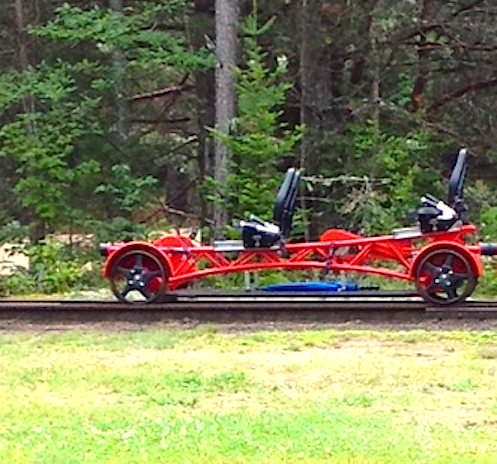
Pictured above is a four-person "rail bike" that is powered in the same manner as a recumbent bicycle  -- by pedaling with one's feet from a sitting or slightly reclining position.  The rail bikes are custom made and come in two-person or four-person versions.  Two weeks ago today our family boarded two of the four-person rail bikes that we had reserved many weeks earlier for the inaugural season of this unique outdoor experience.  Three generations of the family went for a roughly 6-mile trek on the rails between Lake Clear Junction and Saranac Lake. [Many thanks to daughter-in-law Pamela for discovering this opportunity and for making the arrangements!] 

As some background to this Adirondack experience, a little railroad history is in order. 

In 1890, William Seward Webb, the husband of a Vanderbilt heiress, financed the construction of a railroad (the Mohawk & Malone Railway) through the Adirondack wilderness so he could more conveniently reach his Great Camp known as Nehasane Park.  Webb's railroad later became part of the New York Central Railroad (NYC) system that carried wealthy families such as the Roosevelts, Whitneys, Morgans, Vanderbilts, and others to their Great Camps in the Adirondacks.

By 1961 sections of the railroad line were abandoned, but passenger service from Utica to Lake Placid (known as the Adirondack Division) continued scheduled service until April 1965.  Then in 1968 the NYC merged with rival Pennsylvania Railroad to form Penn Central.  Although Penn Central went into bankruptcy in 1970, declining freight service on the line continued until about 1972 when Penn Central applied to the NY Public Service Commission to abandon the line.  In 1975 the state of New York purchased the abandoned line and it remained essentially dormant and decaying from then on with one notable exception -- an ephemeral return to service for the 1980 Winter Olympic Games in 1980 in order to run passengers from Utica to Lake Placid.

In 1992, some railroad enthusiasts formed in order to found and operate a 4-mile section of track as the Adirondack Centennial Railroad (ACR).  When more than 50,000 passengers took advantage of the ride in the first season, the state allowed continued passenger service on an expanded section and in the summer of 1994 the ACR morphed into the Adirondack Scenic Railroad operated by the not-for-profit Adirondack Railway Preservation Society, Inc.

In the six years between 1994 and 2000, the Adirondack Scenic Railroad restored sections of rail so that passenger service could operate between Lake Placid and Saranac Lake and other sections much further to the south. However, the tracks between Big Moose Lake to the southwest of Lake Clear and Saranac Lake to the east of Lake Clear -- some 60 miles or more that includes the Lake Clear Junction to Saranac Lake leg -- needs a great deal of work to make it safe for sustained passenger train service. In the meantime, the state of New York designated the corridor as a multi-use area for limited seasonal rail traffic and as a snowmobile trail during the winter. This left an opening for the creative entrepreneurs behind "Rail Explorers."


The rail bikes now traverse the six miles of track between Lake Clear Junction and Saranac Lake and thus open this wooded corridor among the lakes and remote meadows along the route for the first time since 1980 -- and without what many consider the intrusive noise and pollution that can be caused by vintage trains. The run from Lake Clear to Lake Saranac is particularly easy given the long stretches of downhill track that allow a whizzing ride with little or no effort by the riders.  The uphill reverse route from Lake Saranac to Lake Clear Junction is another story, but it can be done by almost anyone with a bit more effort. The specially built Adirondack rail bikes are the first in America and the season is very limited, so this is an experience that needs to be planned.  

But the future of this unique Adirondack experience may be in some doubt.  Just this past June, the New York State Department of Environmental Conservation (the DEC) along with the Department of Transportation (DOT) stated that they will amend the unit management plan for the Remsen to Lake Placid rail corridor.  They reason that since the Adirondack Scenic Railroad runs tourist excursions on small sections of track, the vast majority of the line's midsection between Thendara and Lake Placid (including Lake Clear Junction to Lake Saranac) is unused.  The new DEC/DOT proposal calls for the removal of tracks from Tupper Lake through Lake Clear Junction to Lake Placid in order to construct a 34-mile long route for hikers, cyclists, cross country skiers, and snowmobilers.  The plan has wide support from the Adirondack Rail Trail Advocates.  The plan would also restore 44 miles of passenger rail service through backcountry wilderness to Tupper Lake from points south and the village of Tupper Lake has already completed restoration of its train depot in anticipation of this development.  More about the proposed plan can be seen here.

It is highly recommended that if you are in the high peaks area of the Adirondacks this summer, you should take in this unique outdoor experience.  While we hope the rail bikes have a future in the Adirondacks, use of the current rail bike route conflicts with the DEC/DOT stated corridor plan and therefore the Lake Clear to Saranac Lake experience might be a fond memory a few short seasons from now.

Rail Explorers staff members prepare rail bikes for the run from Lake Clear Junction to Saranac Lake.

All aboard!  The lead bike in our two four-seaters. [Yours truly in the olive drab hat.]

Our second four-seater with son (Christopher) in the headband, sister-in-law (Kathy), and brother-in-law (Patrick).


The rail bikes do not travel linked together. At least 30 feet is required between bikes during
travel. This photo shows the rubber bumpers to absorb any inadvertent contact when gathering
for the few road crossings, which are supervised by traffic flagmen provided by Rail Explorers.

Son (Jonathan) with our granddaughter Nora snuggled in for the ride!

Gathering for a view across backcountry meadows.  Yours truly pointing out some interesting flora.  Nora with her parents Jonathan and Pamela and Christopher all paying rapt attention.

_ _ _ _ _ _ _ _ _ _ _ _ _ _ _

All photographs taken on July 30, 2015.  All images above are from the originals in the collection of the author.
_ _ _ _ _ _ _ _ _ _ _ _ _ _ _

Copyright 2015, John D. Tew
_ _ _ _ _ _ _ _ _ _ _ _ _ _ _

Thursday, August 21, 2014

Almost Heaven (August 21, 2014) -- The Adirondacks Might Not be Heaven On Earth . . . But You Can See It From There!


No internet, no cell phone, no TV, no Blackberry. 

Lakes, mountains, and the call of the loons.

 Warm days, cool nights and 

countless stars.

A-D-I-R-O-N-D-A-C-K-S!


_ _ _ _ _ _ _ _ _ _ _ _ _ _ _

All photos by the author -- August 2014.
_ _ _ _ _ _ _ _ _ _ _ _ _ _ _

Copyright 2014, John D. Tew
_ _ _ _ _ _ _ _ _ _ _ _ _ _ _


Thursday, March 13, 2014

Those Places Thursday (March 13, 2014) -- Mt. Colvin in the Adirondacks

Molly on Mt. Colvin (August 29, 1976)

John on Mt. Colvin (August 29, 1976)

I have written a few times about the importance of the Adirondacks in upstate New York to our family. After visits to the region in his youth and then years of fly fishing in the area while dropping off his daughter Kathy for her summer counselor job at Eagle Island Girl Scout Camp in Saranac Lake, Molly's father and mother bought a "camp" right on Lake Placid.  The family enjoyed at least three decades of regular visits to "Placid Place" in the High Peaks region of the Adirondacks. Molly and I spent our honeymoon at the camp, and later our sons learned to swim in the lake. When they were older, our sons and their cousins and friends attended several weeks of soccer camps at North Country School in Lake Placid. In many ways ours sons grew up with Lake Placid and the Adirondacks as a central part of their infancy through their early adulthood. We have all hiked, climbed, canoed, backpacked, and swum extensively in the region.  In August 1998 our immediate family embarked on a continuous backpacking trek of the entire 133-mile Northville-Lake Placid Trail.

There are forty-six peaks in the Adirondacks that are over 4,000 ft. elevation (above sea level) and a climbing fraternity known as the Adirondack Forty-Sixers or simply the "Forty-Sixers" exists for those who can establish that they have climbed all of them. In August 1976, during our honeymoon week, Molly and I climbed our first Forty-Sixer peak as shown above -- 4057 ft. Mt. Colvin.
_ _ _ _ _ _ _ _ _ _ _ _ _ _ _

As a reminder, "camp" is the Adirondack term that elsewhere would be called a cottage or cabin.  If the camp is particularly old, large, and luxurious it is referred to in the Adirondacks as a "Great Camp" and is usually associated in some fashion with the rich and famous of days past.

Photographs from the personal collection of the author.
_ _ _ _ _ _ _ _ _ _ _ _ _ _ _

Copyright 2014, John D. Tew
_ _ _ _ _ _ _ _ _ _ _ _ _ _ _

Wednesday, November 13, 2013

Wordless Wednesday (November 13, 2013) -- Suggested Captions Solicited Via Comments . . .


_ _ _ _ _ _ _ _ _ _ _ _ _ _ _

Original photograph in the collection of the author.
_ _ _ _ _ _ _ _ _ _ _ _ _ _ _

Copyright 2013, John D. Tew
_ _ _ _ _ _ _ _ _ _ _ _ _ _ _

Thursday, October 17, 2013

A Very Special, Placid Place -- Those Places Thursday (October 17, 2013)


Eventually known simply as "Placid Place," Molly's parents' "nice little camp" right on Lake Placid in the Adirondack region of Upstate New York was a much-loved family get-away.  Dan and Doreen O'Kane owned Placid Place for several decades and we and our sons spent time there virtually every summer.  Both sons were dipped in the waters of Lake Placid within months of being born and they attended soccer camp at the Northwood School in Lake Placid for several summers.

In the Adirondacks, vacation homes great and small that are located outside towns or villages on lakes, rivers, or in the back woods are known not as "cottages" or "cabins," but rather as "camps."  Placid Place was originally a very small "fish camp" that was used seasonally by the original owner.  It consisted of just the right side of the structure shown above where the two sets of twin windows are seen. After Molly's parents bought the camp, the interior of the original structure was re-configured and upgraded and then later an addition to the left was added.  The deck was also expanded so that it ran the full length of the front and wrapped around to run the width of the original structure to the right so that it formed an "L" shape hugging half the camp.  

The camp sat a mere 50 feet or so from the shore of the lake where a modest, unobtrusive wooden platform nestled under the shoreline trees and from which a straight, removable dock sat out into the lake perhaps 15 -18 feet.  It was deep enough off the end of the dock that we could dive right into the lake and the water was crystal clear so that we could easily see bass down 10-12 feet.  

There were views out over the lake from every room in the front of the camp (the dining room, the kitchen, and the living room).  None of the four bedrooms had lake views, but they each looked out into the surrounding woods.  The camp had two full baths and a walk-out basement that was used mainly to store canoes, tools, a second refrigerator, and any other gear that needed a home.  The camp was a four-season camp with baseboard electric heat, a fireplace in the living room, and a cast-iron wood stove in the dining room area, so that it was used during winter holidays and for the 1980 Winter Olympics held at Lake Placid.  Placid Place was accessible by car down a private, three-mile dirt and gravel road.

Placid Place in winter on completely frozen and snow-covered Lake Placid.  The dock is out of the lake for the winter, but the wooden platform from which the dock ran out into the lake can be seen to the left.

The view from Placid Place looking west down Sunset Straight between Buck and Moose Islands

The new owners of Placid Place have added a beautifully crafted, but completely incongruous pagoda-style boathouse to the shoreline
_ _ _ _ _ _ _ _ _ _ _ _ _ _ _

All photographs by the author.
_ _ _ _ _ _ _ _ _ _ _ _ _ _ _

Copyright 2013, John D. Tew
_ _ _ _ _ _ _ _ _ _ _ _ _ _ _

Friday, September 6, 2013

Missing The Adirondacks -- Friday Fotos (September 6, 2013)

Now that we have left Labor Day 2013 and the symbolic end of summer behind us, we find ourselves with only 15 days remaining until the end of astronomical summer (it ends in the Northern Hemisphere on Saturday, September 21st).  

As always at this time of year, I find myself anticipating with pleasure the change of seasons, but I already miss summer in the Adirondacks -- and so today's Friday Fotos is a fond farewell in photographs (until next year) to the Adirondack summer that means so much to our family!

Early Morning Calm on Lake Clear 

A Running Gang of Common Mergansers (Mergus merganser)
A Common Loon (Gavia immer) in summer plumage

Blue Jay feather in a Basswood leaf

The pristine waters of Copperas Pond

Moonrise Over Lake Clear

_ _ _ _ _ _ _ _ _ _ _ _ _ _ _

All photographs by the author.  All rights reserved.  No reproduction or use of the photographs is allowed without the permission of the photographer/author.

_ _ _ _ _ _ _ _ _ _ _ _ _ _ _

Copyright 2013, John D. Tew
_ _ _ _ _ _ _ _ _ _ _ _ _ _ _