Tuesday, January 21, 2014

Tombstone Tuesday (January 21, 2014) -- Eber Miller Carpenter


Eber Miller (1805 - 1877) is my 3rd great grandfather.  He was married to Abby Hunt (1807 - 1893) and to my knowledge (thus far) he and Abby had two children: Ruth Ann Miller, my 2nd great grandmother (1828 - 1893); and Cornelia Crosby Miller (1833 - 1914). Eber, Abby and Ruth are all buried in  what is now designated as Rhode Island Historical Cemetery, Cumberland 3 on Dexter Street in Cumberland. In fact, many of my Carpenter, Miller and Hunt ancestors are laid to rest in this particular cemetery.

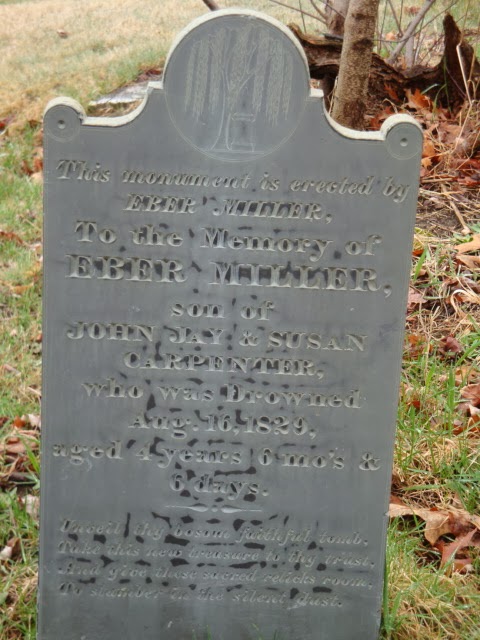
In late March 2010, I visited the Dexter Street cemetery and took many photographs of family headstones, but this sad one especially caught my eye for a couple of reasons.  For one, it was in remarkably good shape compared to most of the others in the cemetery.  For another, it involved a very sad loss of a young child by drowning AND it presented a mystery.

The headstone reads . . . 

                                        This monument is erected by
                                            Eber Miller,
                                     To   the   memory   of
                                            EBER MILLER,
                                                 son of
                                        John Jay & Susan
                                            CARPENTER
                                         who was Drowned
                                          Aug. 16, 1829,
                                      aged 4 years 6 mo's &
                                                   6 days.
                                                    
                                                   *  *  *
                                Unveil thy bosom faithful tomb,
                                Take this new treasure to thy trust.
                                And give these sacred relicks room,
                                To slumber in the silent dust.

My 3rd great grandfather, Eber Miller, obviously had this headstone prepared for his young namesake, Eber Miller Carpenter, who drowned as a boy of less than five. The mystery was . . .  what was the exact connection between Eber Miller and John Jay Carpenter and his wife, Susan? Eber and Abby's daughter, Ruth Ann Miller, married into the Carpenter family when she married my 2nd great grandfather Samuel Carpenter, but that Carpenter connection was a generation away.  The drowned boy, Eber Miller Carpenter, was born in 1825 and Ruth Ann Miller, who would eventually marry my 2nd great grandfather Samuel Carpenter, was not even born until August 23, 1828 -- almost exactly a year before Eber Miller Carpenter drowned.  Eber M. Carpenter's father, John Jay Carpenter did not yet appear in my Carpenter family tree.

Consulting my copy of the 1896 Carpenter genealogy compiled by Amos Bugbee Carpenter (the "ABC") at page 297, I learned that the maiden surname of John Jay Carpenter's wife, Susan, was "Hunt."  John J. Carpenter is also buried in the Dexter Street cemetery, and his headstone states that he died May 21, 1879 -- the same date stated in the Amos B. Carpenter genealogy.


John Jay's wife Susan was born in 1796.  She and John Jay married on January 2, 1819. The supposition therefore -- yet to be confirmed -- is that Susan was the older sister of my 3rd great grandmother Abby Hunt who married Eber Miller.  Eber Miller provided the headstone for his drowned namesake, Eber Miller Carpenter, the nephew of his wife Abby.  

Eber and Abby's daughter, Ruth Ann Miller, would later marry Samuel Carpenter in 1852, so the question became, "Were John Jay Carpenter and Samuel Carpenter, related -- and if so, how?" This will be the subject of a future post.  
_ _ _ _ _ _ _ _ _ _ _ _ _ _ _

Photograph by the author (March 2010)
_ _ _ _ _ _ _ _ _ _ _ _ _ _ _

Copyright 2014, John D. Tew
_ _ _ _ _ _ _ _ _ _ _ _ _ _ _

Monday, January 20, 2014

Martin Luther King, Jr. Day (January 20, 2014) -- Honor, Superbowl History, and Remembrance

Gallery of 20th Century Martyrs at the Collegiate Church of St. Peter at Westminster ("Westminster Abbey"), London, England.  Martin Luther King is second from the right with Mother Elizabeth of Russia to his right, Archbishop Oscar Romero to his immediate left and Pastor Dietrich Bonhoeffer to his far left.

Today is the 28th observation of Martin Luther King, Jr. Day, the official federal holiday marking the birthday of Martin Luther King, Jr. Dr. King was actually born on January 15, 1929, but pursuant to the "Uniform Monday Holiday Act," the celebration of Martin Luther King, Jr. and his birthday has been officially set for observation on the third Monday of each January.

The creation of this holiday did not have a smooth road and was controversial among certain segments of the political and social spectrum in the United States.  The idea of a holiday to honor King was first proposed and promoted by labor unions. Dr. King was in Memphis, Tennessee to support black public works employees who were members of labor union AFSCME Local 1733 when he was shot and killed on the balcony outside his room in the Lorraine Motel. Black union members had been mistreated for some time and King was supporting them in their efforts to prevent repeats of incidents such as when black road repairmen were paid for two hours of work while white repairmen were paid for the entire day when the workforce was sent home due to bad weather.

The first bill to establish a holiday in honor of Martin Luther King, Jr. was submitted by Senator Edward Brooke (Republican from Massachusetts) and Representative John Conyers (Democrat from Michigan).  The bill came to a vote in 1979 and fell short of passage by 5 votes. The main arguments against the bill were: (1)  that only two other people had federal holidays specifically honoring them -- George Washington and Christopher Columbus; (2) that such a paid holiday for federal workers would be "too expensive;" and (3) that a holiday to honor a private citizen who had never been elected to public office would be contrary to tradition [conveniently forgetting I suppose that Christopher Columbus had never been elected to public office and was never even a citizen of the United States].  

It was not until November 2, 1983 that President Ronald Reagan finally signed into law a bill establishing Martin Luther King, Jr. Day as a federal holiday (although President Reagan initially opposed the holiday on cost grounds). The initial observation of the holiday was set for January 20, 1986 -- the third Monday of January that year -- but not without opposition and reluctance to actually observe the holiday. The two Senators from North Carolina (Republicans Jesse Helms and John East) opposed the holiday on the grounds King was not important enough to receive such an honor.  They attacked King for his opposition to the Vietnam War and his alleged "Marxism." Helms went so far as to filibuster the holiday bill in October 1983 and he submitted a 300-page report accusing Dr. King of having associations with communists. In a dramatic response to Helms on the floor of the Senate, Sen. Daniel Patrick Moynihan (Democrat from NY) threw down the Helms report and stomped on it calling it "a packet of filth."

Even after passage of the federal MLK Day holiday into law, opposition and attempted limitation continued. For example, John McCain (Republican Senator from Arizona) voted against the federal holiday and then later defended Arizona Governor Evan Mecham (who was later impeached and removed from office in disgrace for other reasons) when he rescinded the state King holiday established by Mecham's predecessor (Democrat Gov. Bruce Babbitt) in 1986. It was only when criticism grew within and without Arizona that Sen. McCain changed his position and encouraged recognition of the holiday despite Mecham's opposition and rescission. Nevertheless, in 1989 (three years after MLK Day became a federal holiday) Arizona replaced Columbus Day with a King holiday.  As a result, the National Football League threatened in 1990 to move the 1993 Superbowl planned for Arizona to another location.  While the Arizona legislature did pass a bill to keep both Columbus Day and Martin Luther King Day, 76% of Arizona voters persisted in rejecting the King holiday. The NFL subsequently moved the 1993 Superbowl to Pasadena, California and it was estimated Arizona lost $500 million in anticipated revenues as a result!

The last state to have a holiday named after Dr. King was New Hampshire. In 1991, N.H. had created a co-called "Civil Rights Day" in place of another little known or observed holiday called "Fast Day" (a day of public fasting and prayer in New England states from 1670 - 1991).  Civil Rights Day was finally changed to "Martin Luther King Day" in 1999. In 2000 South Carolina made Martin Luther King's birthday an official paid holiday for state workers -- who previously could choose to celebrate MLK Day or one of three Confederate holidays.

*     *     *

I posted here last October  about the importance of pursuing genealogy by looking forward as well as looking into the past -- and to look forward by recording for descendants observations and experiences we personally had around historical events.  And so I want to end this particular post by recalling my experience of the killing of Martin Luther King, Jr. in April 1968 (as best I can recall). 

In April 1968 I was living in New Jersey and I had just turned 16 years old two days before Dr. King was shot and killed in Memphis. I was a sophomore in high school and still one year away from qualifying for a driver's license in New Jersey. Outside of school work, I was a Boy Scout, an avid backpacker (although not yet a competitive track and cross country runner), and a stock-boy at S.S. Kresge's in the Cherry Hill Mall; but I was not particularly aware of or involved in social and political issues other than occasional debates about the Vietnam War stimulated by history and social studies teachers at school.  That all changed in the awful spring of 1968.  It began with the killing of Dr.King and was followed weeks later with the killing of Sen. Robert Kennedy. 

April 4, 1968 was a Thursday -- which was the regular meeting night for our Boy Scout troop. Since I walked to the meetings (which began at 7:00 PM), and our family normally sat down to supper at 6:00 PM, I was up from supper and gone by 6:30 or shortly thereafter -- so I did not learn of the shooting until close to the end of the troop meeting.  [Memphis, TN is in the Central time zone and so was an hour behind New Jersey.]  

Scouts who were dropped off by car were also picked up and some of the parents would arrive before the 8:30 PM end of the meetings.  On this particular night, I remember several parents arriving earlier than usual and some parents appeared to pick up sons that had walked to the meeting.  This was when most of us learned about the shooting and, simultaneously, of Dr. King's death, because he was pronounced dead just after 7:00 PM Central time, which was just before our meeting ended at 8:30 PM Eastern time. Many of the parents looked quite upset and worried and I recall hearing whispered comments about likely violence in Philadelphia just across the Delaware River from the town in which we lived.  There was fear that violence could spread into the suburbs on both sides of the river. I declined more than one offer for a ride home and walked the mile or so home upset at yet another shooting of a national figure as I thought back to President Kennedy's assassination just over four years earlier.

In the days after the killing of Dr. King, the news carried almost nothing but assassination-related stories in print and on TV.  Riots erupted in as many as 125 cities across the country including Pittsburgh, Chicago, Baltimore, New York, and Washington, DC. (where the rioting lasted four days). In Washington crowds later estimated to be 20,000 strong took to the streets and commercial buildings were looted and set afire. The firefighters were prevented from responding by the rioters.  The inner city burned and parts were still a charred, empty zone when I moved to DC to attend law school ten years later in 1978.

The fear and debate about the violent reaction to Dr. King's killing  -- and what it meant for the future of the civil rights movement -- went on for weeks.  And then things got even worse when Bobby Kennedy was killed on June 5, 1968 and a riot broke out at the Democratic Convention in late August! It was an awful spring and summer and it seemed the country was falling apart along race, social and political lines. I and many teenagers had no idea what was happening or how it was going to end.  For many of us it was a sudden awakening to issues and events outside our own insulated worlds and most of us began paying a lot more attention to the nightly news with its images of the war in Vietnam, the "women's lib" protests, the black athlete protests at the Mexico Olympics, and the hijack of a New York commercial airliner to Cuba.
_ _ _ _ _ _ _ _ _ _ _ _ _ _ _

Photograph by T. Taylor 19 April 2011.  The photographer has placed the image in the Creative Commons and granted license to copy distribute and transmit so long as attribution is stated. http://en.wikipedia.org/wiki/File:Westminster_Abbey_C20th_martyrs.jpg        
_ _ _ _ _ _ _ _ _ _ _ _ _ _ _

Copyright 2014, John D. Tew
_ _ _ _ _ _ _ _ _ _ _ _ _ _ _  

Saturday, January 18, 2014

Saturday Serendipity (January 18, 2014)


Saturdays often allow a more leisurely approach to life than work days. I can more easily post links to some blog posts or other materials I have discovered during the week, or even to those discovered during a Saturday morning coffee and extended surfing of the blogosphere/internet.

Here are a few recommendations for inclusion on your reading list.

1.  Three items this week from the treasure blog known as The Vault. Each will be listed as a separate find with a direct link to the subject article.  In the first, blog editor Rebecca Onion selects a piece on everyday words that meant very different things to our Colonial ancestors. Joan P. Bine, director of the Golden Ball Tavern Museum in Massachusetts, is author of "Words They Lived By: Colonial New England Speech, Then and Now" and she has compiled words in categories (work, the military, drinking, the sea, etc.) to illustrate the change in meaning over the years.  Just one example is "backlog", which to us is something yet to be accomplished or completed.  To our ancestors it was more literally the largest log in the fire set in the back of the kitchen fireplace.  Read more examples here.          
     
2.  If you have Irish ancestors then you need to go to this site selected by UpFront With NGS in this week's Mini Bytes. The Donegal Democrat links to the online archive of 85-year-old recordings so that you can listen to what Irish sounded like almost 100 years ago. You can select various counties. Donegal has 85 recordings, Roscommon has 2, Mayo 33, Derry 11, etc.  Some counties unfortunately do not have any recordings.  Have a listen and read the English transcripts of some wonderful stories!   

3.  I enjoyed Barbara Poole's photos of the homes of Henry David Thoreau -- including a replica of his famous cabin from Walden Pond at Life From The Roots. Barbara has a future venture planned to visit the original location of the Walden Pond cabin and take some photos for us to see. The refocus of Barbara's blog to concentrate on a photo tour of New England locations is a real service to those of us from New England who cannot get there as often as we would like and for those who plan to or hope to visit New England and want to peruse the options they have for a tour.

4.  Here is an interesting post at Laura Mattingly's The Old Truck in the Attic about a mysterious instance of an ancestor having not one, but two tombstones!  

5.  New to me, but a simply wonderful idea, is the Suzanne Winsor Freeman Memorial Student Genealogy Grant  established in 2010 by Denise Levenick of The Family Curator blog in honor of her mother's interest in family history.  The $500 cash award has been awarded to young genealogists between 18 and 25 years old for three years now. Information about the grant for 2014 will be posted at The Family Curator  blog in the near future.

6.  You remember old King Alfred the Great, the Saxon king who ruled from 871 to 899, right? It seems his pelvis bone might have been found after all these centuries! Here is the story as told yesterday in The Telegraph.     

7.  An interesting juxtaposition of new and old is captured in the photos of Jason Reblando in the second selection from The Vault. The tintype process photos show modern working Chicagoans standing with ancient artifacts of their occupations.  Have a look at these arresting photographs here.  

8.  Midge Frazel at Granite In My Blood will be on hiatus from posting gravestone photos at that blog in order to devote time and space to her participation in this year's month-long "Family History Writing Challenge" from The Armchair Genealogist, Lynn Palmero. What caught my eye is that Midge is going to spend a week of blogs during the challenge concentrating on explaining the technology she uses to accomplish her research. See Midge's explanation here and then stop by her blog during late January and February.  She promises lots of photographic cuteness. 

  
9.  And the last of the three selections from The Vault could provide some insight for your family history about why a particular ancestor might have avoided service in the Union Army during the Civil War. One frequent and major cause of exemption from service was an "absence of teeth" because a soldier had to bite off the end of a powder cartridge to load his rifle. The chart of physical examinations shown at this post depicts various occupations, the number in those occupations who were examined for service, and the ratio rejected per 1,000 examined.  There are some fascinating results to ponder. Why, for example would Editors, Watchmen, Upholsterers, and Brokers be rejected for service in such large numbers after physical examination? Have a look here and see if maybe you have some clues about why an ancestor might have been unfit for service in the Union Army even if he otherwise appeared to be of an age to be a prime target for the draft.    
_ _ _ _ _ _ _ _ _ _ _ _ _ _ _

Copyright 2014, John D. Tew
_ _ _ _ _ _ _ _ _ _ _ _ _ _ _

Friday, January 17, 2014

Friday Fotos (January 17, 2014) -- Minnie Jeffs nee Brown


Minnie Brown is the great grandmother of my wife and therefore the great great grandmother of our two sons.  Minnie was born in February 1862 in Ontario, Canada. She was the daughter of Thomas Brown and his wife, Ann Parry.

Minnie married Dr. William Henry Maines Jeffs on Christmas Day 1890 in York, Ontario, Canada. William and Minnie had two sons: Howard Brown Jeffs born in 1891; and George Douglas Jeffs born in 1893.  Both sons became physicians.  

Minnie and William also adopted a little girl named Jeanette who was born in the United States in July 1903.  Jeanette is shown as their adopted daughter in the 1911 Census of Canada when Jeanette was 8 years old, but nothing more is known about Jeanette or what became of her.

Minnie Brown Jeffs died in Toronto, Ontario, Canada on September 25, 1950 at age 88.

_ _ _ _ _ _ _ _ _ _ _ _ _ _ _ 

Original photograph in the family collection.
_ _ _ _ _ _ _ _ _ _ _ _ _ _ _

Copyright 2013, John D. Tew
_ _ _ _ _ _ _ _ _ _ _ _ _ _ _

Thursday, January 16, 2014

Those Places Thursday (January 16, 2014) -- National Jamborees, Boy Scouts of America


In 1969 I was a Boy Scout and that summer I attended the Boy Scouts of America National Jamboree held at Farragut State Park outside Coeur d'Alene, Idaho.  National Jamborees are held by the BSA about once every four years.  The 1969 Jamboree was the first of five National Jamborees that I have attended.  The other four I attended as an adult and I served in various capacities including as a Jamboree Troop 1st Assistant Scoutmaster, as a Jamboree Troop Scoutmaster, as a member of the Northeast Regional Staff (Action Alley), and, during the 100th BSA Anniversary Jamboree in 2010, as a member of the Jamboree Security Staff.  Both of our sons are Eagle Scouts.  One attended the 1997 Jamboree as a youth participant and the other attended the 2001 Jamboree as a youth participant.  National Jamborees are part of our family history.

The 1969 National Jamboree was actually held five years after the previous Jamboree held at Valley Forge, Pennsylvania in 1964.  The 1969 National Jamboree was delayed for a year because in 1967 the Boy Scouts of America hosted the World Jamboree for the first time and the World Jamboree was held at Farragut State Park. 

The Boy Scouts of America have held eighteen* National Jamborees as of the one held the summer of 2013.  The first Jamboree was to have been held in Washington, DC in August 1935, but it had to be canceled due to a polio epidemic. The first BSA National Jamboree to actually take place was held on the Mall in Washington, DC in 1937 with 27,238 youth and adult participants from around the country. 

A Jamboree usually lasts for seven days as it did in 1953, 1957, 1960, 1964, 1969, 1973, 1977, 1981, 1985, 1989, 1993; but in 1937, 1950, 1997, 2001, 2005, 2010 and 2013 the Jamborees were ten days long.  Over the years, National Jamborees have been held in eight different locations in the country: Washington, DC (1937); Valley Forge, PA (1950, 1957 and 1964); Irvine Ranch, CA ( 1953); Colorado Springs, CO (1960); Farragut State Park, ID (1969 and 1973*); Moraine State Park, PA (1973* and 1977); Fort A.P. Hill, VA (1981, 1985, 1989, 1993, 1997, 2001, 2005, and 2010); and, most recently, at the new BSA-owned "Bechtel Family National Scout Reserve - The Summit" in WV. Now that the BSA owns and controls 10,600 acres in West Virginia, The Summit will become the permanent home for all future National Jamborees. 

National Jamborees have always attracted tens of thousands of participants (youth and adult) from around the U.S. and some foreign countries.  The smallest of the National Jamborees was in 1937 at 27, 238 participants, but the Jamborees in 1977 and 1981 were not much larger at 28,601, and 29,765 participants respectively.  Setting aside the unique East/West Jamborees of 1973, which had a combined total of 73,610 participants, the largest single Jamboree is still the one held at Colorado Springs in 1960 with 56,377 participants.  The largest National Jamboree in the last 48 years has been the 2010 Jamboree, which was held in the year of the 100th Anniversary of the founding of the Boy Scouts of America and had 43,434 participants.  That made the 100th Anniversary Jamboree the sixth largest Jamboree after 1960 (56,377), 1957 (52,580), 1964 (50,960), 1950 (47,163), and 1953 (45,401). 

As a youth participant at the 1969 National Jamboree, I was a member of a temporary "expeditionary Troop" formed from registered Scouts in Burlington County, NJ where my family lived at the time. Our Jamboree Troop #26 (pictured at the top of this post) was comprised of four "patrols" and I was the Patrol Leader for one of them -- the "Unami" patrol. Our patrol totem is hanging second from the left on the Troop's gateway in the photo above.

The shape of our patrol totem is a turtle because the area that became Burlington County, New Jersey was a small part of the ancestral home of the Lenape (lun-NAH-pay) people who were later called the  "Delaware" by the English. The Lenape were separated into three main sub-tribes: the Minsi symbolized by the Wolf; the Unami symbolized by the Turtle; and the Unalachtigo symbolized by the Turkey. The founder of the Province of Pennsylvania, William Penn, made his 1682 peace and land purchase treaty ("Penn's Treaty") with the Unami and the Unalachtigo peoples. Since the Unami lived in the areas bordering both sides of the Delaware River where the Philadelphia environs and Burlington County are now located, we decided to name our patrol the Unami.


The participant patch for the BSA's 1969 National Jamboree


The participant patches for (left to right top to bottom) the BSA's 2010, 2005, 2001 and 1997 National Jamborees

Oh, in the event you are trying to find me in the Troop 26 photograph above, I am the one kneeling at the far right in the second row. So young, such hair . . .
_ _ _ _ _ _ _ _ _ _ _ _ _ _ _
* Purists will sometimes argue that there have actually only been seventeen truly "National" Jamborees because in 1973 the Jamboree was actually split between two locations -- one in the east (Moraine State Park, PA) and one in the west (Farragut State Park, ID) -- AND they were not even held simultaneously because the western location started on August 1, 1973 and the eastern location started two days later on August 3, 1973.  The 1973 Jamboree is unique, thus far, because all other Jamborees have occurred at a single location.
  
Original photograph in the personal collection of the author.

The image of the 1771-72 Benjamin West painting of William Penn's treaty with the Indians is from the Pennsylvania Academy of Fine Arts in Philadelphia.  The work is in the public domain because it was published or registered before January 1, 1923. http://en.wikipedia.org/wiki/File:Treaty_of_Penn_with_Indians_by_Benjamin_West.jpg 

Images of the Jamboree participant "patches" for the 1969, 2010, 2005, 2001 and 1997 National Jamborees made from original patches in the personal collection of the author.
_ _ _ _ _ _ _ _ _ _ _ _ _ _ _

Copyright 2014, John D. Tew
_ _ _ _ _ _ _ _ _ _ _ _ _ _ _

Wednesday, January 15, 2014

First Cars (January 15, 2014) -- Massachusetts License Plate No. 19


My maternal grandmother's older sister, Helen R. Cooke, married Dr. Frederick Alpha Roberts in 1922.   They lived all their married life in Pittsfield, Massachusetts. Helen died in Pittsfield at age 95 in 1987.

Fred was born in Jacksonville, Windham County, Vermont in 1863. He attended New York University for a time, but apparently left to go to work in Boston for several years as a clerk. His uncle, Dr. Oscar S. Roberts of Pittsfield, Massachusetts, convinced Fred that he should go to medical school and at age 34 Fred graduated from the College of Physicians and Surgeons in Baltimore, Maryland.  Upon graduation he went to Pittsfield and joined the medical practice of his Uncle Oscar, one of the best known physicians in Berkshire County.  Their offices were in the Whelden Block of the city in what was known as the Pender Building in 1935.  "Dr. Fred" became widely known as an obstetrical physician over the years and when he died in 1935 at age 72, he was the fifth oldest practicing physcian in Pittsfield, Massachusetts.

Both Oscar Roberts and his nephew Fred were avid motorists.  Oscar was the first person in Pittsfield to own an automobile and Fred was a charter member of the Automobile Club of Berkshire County, having joined when it was formed in 1903. 

The license plate shown above is the plate that was issued to Dr. Fred Roberts and was retained as an active plate by his widow, my Grand Aunt Helen, for decades afterward. In the early days of car registration and license plates, the plates were issued in sequential order.  Later when sequential numbering was abandoned, those with active sequential numbers were allowed to keep their plate numbers so long as the registration remained active. My aunt used to get repeated offers to take over her plates, which became one of the oldest active plates in the state as the years went by. Dr. Fred held plate No. 19 for some 32 years and it was the lowest registration plate in Berkshire County when he died in 1935. 

I now have the plate shown above, a 1966 issue of Plate No. 19 to my Grand Aunt Helen.
_ _ _ _ _ _ _ _ _ _ _ _ _ _ _

Image of the original license plate in the personal collection of the author. 
_ _ _ _ _ _ _ _ _ _ _ _ _ _ _

Copyright 2014, John D. Tew
_ _ _ _ _ _ _ _ _ _ _ _ _ _ _ 

Monday, January 13, 2014

A Genealogy Blogosphere Thank you! (January 13, 2104)


2014 has already been a busy year.  

I returned to the office on January 6th after a very enjoyable holiday season with family and friends. Molly went back to her teaching about the same time after a brief hiatus to allow for snow and extreme cold school cancelations. And then Molly and I just returned late yesterday from the wedding of our nephew in Philadelphia this past weekend.

While at the wedding reception I was able to spend some time in genealogy conversation with my nephew's cousin from his mother's side. "Kenny" and I have communicated about our mutual interest in family history over recent years and we both stood there at the reception -- cameras in hand to record yet another family history event -- chatting about genealogy while the reception whirled around us. 

We discussed my year-old blogging adventure and Kenny had kind words for the blog based on a few visits. I spent a good deal of time encouraging him to start his own family history blog as soon as possible and I ran down some of the many benefits of being able to share -- and thereby preserve via wider distribution -- all the family history and treasures he has been able to accumulate. What I forgot to emphasize to Kenny was the wonderful community of people that inhabit the genealogy blogosphere!

During this first year of genealogy blogging, I have come to meet a couple of distant cousins and many other kind, helpful, and encouraging genealogy bloggers. I have developed a circle of "Blog Acquaintances" and several have become friends that I just happen not to have met face-to-face as yet. One of those friends wrote me an email and left a comment on my Blogiversary post while Molly and I were at the wedding in Philadelphia.  

Barbara Poole, of Life From The Roots blog, wrote to congratulate me on completing my first year of blogging and to note how The Prism had received the honor of being recognized by one of the premier genealogy blogs in a round-up of blogs for 2013. And it was Barbara's kindness in sending her congratulations that reminded me that in the rush of the New Year I had completely forgotten about sending a very appreciative 'Thank You" for the 2013 round-up mention.  Thanks to Barbara I immediately rectified my faux pas with a direct email today to the blog author. 

While a belated "thank you" is better than none, it is still not as good as a timely note of appreciation; but the bright side here is that Barbara's thoughtful kindness allowed a timely thank you to her, and a blog prompt for today that permits me to (1) offer a broader, more public "Thank You!" to Randy Seaver, genea-blogger extraordinaire at Genea-Musings blog; and (2) to tell Kenny that some of the huge benefits of genealogy blogging are the acquaintances, friendships, supportive encouragement, and distant cousin connections you can make upon entering this wonderful family history community!

So without further ado . . .  thank you again Barbara!  

And, Randy Seaver, a belated but very heartfelt "THANK YOU!" for including The Prism among the 23 blogs you mention as your picks for "Best of the Genea-Blogs for 2013." To be mentioned in the same company as the well-established blogs that have made your list for two or even three years, is . . . I am truly at a loss for words. I can say that your inclusion of The Prism has made my year -- and 2014 is only 13 days old!!  

One other thing I will say -- and that I think all of the bloggers you mentioned would join with me in saying -- is that your list (being understandably and properly modest) left out one of the very "Best of the Genea-Blogs for 2013" (and past and future years), so readers should add to their copy of your list Genea-Musings by Randy Seaver found at this link EVERY day!  As others have said -- and I echo -- I do not know how you do it, but we are all glad you and others (such as Thomas MacEntee)  are able to do what you do and that you keep it up! 

Warm regards and best wishes for 2014 to Randy and all the other members of the genealogy blogosphere community! 
_ _ _ _ _ _ _ _ _ _ _ _ _ _ _

Copyright 2014, John D. Tew
_ _ _ _ _ _ _ _ _ _ _ _ _ _ _    

Sunday, January 12, 2014

Samaritan Sunday (January 12, 2014)


[If you should choose to adopt this prompt to contribute your own stories of folks who have gone out of their way to lend genealogy-related assistance to others, I would greatly appreciate a mention to Filiopietism Prism whenever you do so.  Thank you!  And please do use the same photograph below to illustrate the prompt.  ;-) ]


Winning a lottery is a fantasy for many, but how many have the opportunity to win a genealogy lottery set in motion by a Good Samaritan who sought to reunite a family with 120 years of memories?  Keith Bremmer of Windsor, Ontario, Canada and his cousin, Margaret Turner from Acton, Ontario, Canada (now living at Lake Chapala outside Guadalajara, Mexico), were participants in just such a lottery. 

Keith and Margaret's great grandparents, George and Jean Bremmer, came to Canada from Scotland in 1890 and by 1923 they were living in Kitchener, Ontario. One of the family items they had was a small wooden, velvet-lined lap desk in which they kept such things as a lock of hair, photos of family members taken in Scotland, and other mementos.  

Somehow after George and Jean passed away (1923 and the early 30s respectively), the lap desk and all its contents left the possession of family members and eventually found its way into a Toronto antiques shop.  Marvin Allen, a collector of inkwells, happened across the lap desk and thought it would fit in well with his collection --  so he bought it.  Marvin died in 1995 and his daughter, Marlee Petroff, ended up with the lap desk and the Bremmer family history it contained.

To find out what happened next and how Keith Bremmer and Margaret Turner found themselves entered into a "genealogy lottery" involving the lap desk, go here for the details and to see photographs of the lap desk, Good Samaritan Marlee Petroff, and family pictures from inside the desk.  

_ _ _ _ _ _ _ _ _ _ _ _ _ _ _

Photograph of the The Good Samaritan sculpture by Francois-Leon Sicard (1862 - 1934).  The sculpture is located in the Tuileries Gardens in Paris, France.  The photograph is by Marie-Lan Nguyen and has been placed in the public domain by her. See, http://commons.wikimedia.org/wiki/File:Good_Samaritan_Sicard_Tuileries.jpg
 _ _ _ _ _ _ _ _ _ _ _ _ _ _ _

Copyright 2014, John D. Tew
_ _ _ _ _ _ _ _ _ _ _ _ _ _ _