Saturday, March 26, 2016

Saturday Serendipity (March 26, 2016)


The recommended items of interest for this week are as follows . . . 

1.   Today is the last Saturday in March and therefore this is the last opportunity for Saturday Serendipity to recognize Women's History Month with a recommended "listen" as opposed to a recommended read (as is more usual for Saturday Serendipity). This week I return to Nate DiMeo's audio podcast, the memory palace, to recommend you listen to his piece on Margaret Knight. To learn who Margaret was and why she has an important (though little known) place in Women's History, have a listen to Episode 78: No. 116,842.  You will be glad you did.  

2.  The Weekly Genealogist by NEHGS mentioned a very useful and interesting piece this week that ran in the Boston Globe. Almost all of us at one point or another have been flummoxed and frustrated by the need to decode and transcribe the cursive handwriting in old land records, diaries, letters, etc. The Norfolk County Registry of Deeds in Massachusetts is now about to complete a project designed to transcribe handwritten land records from 1793 to 1900. To learn more about this project, which is underway at the registry in Dedham and is said to be the first project of its kind, go here.   

3.  Judy Russell, The Legal Genealogist, has a new post about a birth location puzzle she and a cousin have encountered based on their research. The puzzle emerged when they participated in the recent challenge to color code the location of the birth of ancestors.  Read about the challenge and their conundrum here.  Judy also provides a link for a template to create your own color-coded chart of ancestor birth locations.

4.  I must admit that the various commonalities and causation pedigrees that many genealogists have created for their families is a new and intriguing concept to me. Laura Mattingly of Old Trunk in the Attic blog posted last weekend about her creation of a pedigree chart to depict the common characteristics and experiences she shares with her ancestors. Read about these kinds of projects and Laura's creation here.

5.  As part of a continuing interest in mentioning possible esoteric sources for genealogy clues and data, I came across a post at The Vault that could hold some very sad but hidden nuggets for some genealogists. A recently published book by Peter Manseau titled, "Melancholy Accidents: Three Centuries of Stray Bullets and Bad Luck," collects notices of fire arms tragedies from 1739 to 1916. It might be possible for some mysteries about ancestor or relative deaths to be answered by investigating the information in this book.  To read more about the book and to see several of the newspaper notices the author collected, go here

6.  And finally, since as genealogists we all deal with the subject of death in one way or another, there is a lengthy, but very interesting, piece at Wait But Why blog about the dream of defeating death through what is called "cryonics" or "cryogenics" (the freezing of the body after death).  About 300 people are presently being preserved in vats of liquid nitrogen in the hope of one day being able to live again. How does this process work and what is the procedure for becoming a "cryonicist?" If interested, you can read much more about this subject here.    
_ _ _ _ _ _ _ _ _ _ _ _ _ _ _ 

Copyright 2016, John D. Tew
_ _ _ _ _ _ _ _ _ _ _ _ _ _ _

Saturday, March 19, 2016

Saturday Serendipity (March 19, 2016)


The recommended items of interest for this week are as follows . . . 

1.   As March and Women's History Month comes slowly to a close, I'd like to introduce (or perhaps re-introduce) readers to Nate DiMeo's excellent history podcast called "the memory palace." A former colleague introduced me to this audio podcast a few years ago and I keep coming back to it time and again to listen to new episodes (especially when on long road trips). Nate mines the annals of little known, obscure historical events and the people involved in them. And like all history sources, we genealogists never know when we might come across a nugget to enhance our family genealogies. I highly recommend the memory palace and as a contribution to Women's History Month I provide this link to Episode 76: Mary Walker Would Wear What She Wanted -- a 9-minute sample of the memory palace and a poignant reminder of the obstacles faced by women in 19th Century America.

2.  How cool is it to discover that a historic Colonial house built in 1692 that you have seen (but never up close until recently) was owned by the brother of the wife of your 2nd cousin, 7 times removed? It is pretty darn cool when you find out who the cousin was!  To find out, read Barbara Poole's post here -- complete with photos of the house -- at Life From The Roots blog.

3.  And how cool is it when a genealogy-minded Good Samaritan reads a piece on your blog and then sends you a day book and other items that belonged to a sought after relative? Read here Diane Boumenot's post and see photos of the items and the relative at On Rhode Island Family blog.    

4.  James Tanner at Genealogy's Star blog has two posts this week about preparing to search a graveyard. If you have ever thought about doing such a search, you would be well advised to read both posts.  You can read Part One here and Part Two here

5.  We genealogists always pay attention to surnames -- and to given names when looking for specific individuals -- but how often do we know or pay attention to middle names?  Often middle names are family surnames and they can provide very useful clues for our research. Now there is a resource for discovering middle name frequency over the last twelve decades (1880-2000). Thanks to UpFront With NGS blog, you can read about this resource and get a link to the database here

6.  And finally for this week, Judy Russell at The Legal Genealogist blog has reprised a very interesting and useful post -- first published two years ago -- about providing a citation to an image.  You can read the post here
_ _ _ _ _ _ _ _ _ _ _ _ _ _ _ 

Copyright 2016, John D. Tew
_ _ _ _ _ _ _ _ _ _ _ _ _ _ _

Saturday, March 12, 2016

Saturday Serendipity (March 12, 2016)


From the road this weekend as we visit our granddaughter Nora in New Jersey . . .  less than a handful of  recommended reads for the weekend.

1.  The Weekly Genealogist of NEHGS reminds anyone interested in ancestors or relatives who lived in towns in Massachusetts that in the early years of the 20th Century NEHGS was a moving force in getting legislation to fund the production of vital statistic books for towns in the state through the year 1850. NEHGS has now updated its database of these books to add 2,000 records for the town of Chatham and 4,000+ records for the town of Harwich.  When available, the names of parents and spouses have also been provided. You can get to the database by going here (but you will need to be a member or join). 

2.  As part of its continuing effort to make genealogists aware of FREE (or relatively free) genealogy and family history resources, UpFont With NGS blog provided two new lists of 20 such resources for such diverse locations as the U.S. Ireland, Australia, Brazil, Cuba, Hungary, and even the Vatican.  You can see the list and get links to the new sites here and here.

3.  March is Women's History month and Nancy at My Ancestors and Me blog has provided a list of recommended books along with her reviews.  You can access Nancy's list here.  Only 19 days left in March to read Nancy's eight picks . . . so you better get started!  

4.  Pete Muise of New England Folklore blog has posted a new piece titled "Ghost Stories and Lewiston Maine's Riverside Cemetery." Some nice photos of headstones are provided.  If you have ancestors or relatives now residing in Riverside Cemetery, Peter's piece might give you something to think about if you visit.  You can read the post here.  
_ _ _ _ _ _ _ _ _ _ _ _ _ _ _ 

Copyright 2016, John D. Tew
_ _ _ _ _ _ _ _ _ _ _ _ _ _ _

Saturday, March 5, 2016

Saturday Night Genealogy Fun for March 5, 2016


Randy Seaver's regular Saturday Night Genealogy Fun feature at Genea-Musing blog is a bucket list check sheet this week. Since I have not participated in SNGF in a really long time, I decided to play this week.  My list appears below.  A check in the box means I have done the particular activity involved -- which might be more than some of you wish to know.  


(X) Shot a gun
( ) Gone on a blind date
(X) Skipped school
( ) Watched someone die
(X) Visited Canada
(X ) Visited Hawaii
( ) Visited Cuba
(X ) Visited Europe
(X ) Visited Las Vegas
(X ) Visited Central America

( ) Visited Asia
( ) Visited Africa
(X) Visited Florida
(X ) Visited Mexico
(X ) Seen the Grand Canyon in person
(X ) Flown in a helicopter
(  ) Served on a jury
(  ) Been lost
(X ) Traveled to the opposite side of the country
(X ) Visited Washington, DC

(X ) Swam in the Ocean 
( ) Cried yourself to sleep
(  ) Played cops and robbers
(X ) Played cowboys and Indians
( ) Recently colored with crayons
( ) Sang karaoke
( ) Sang a solo or duet in church
( ) Paid for a meal with coins only
(X ) Made prank phone calls
( ) Laughed until some beverage came out of your nose

(X ) Caught a snowflake on your tongue
(X ) Had children
(X ) Had a pet
(X) Been skinny-dipping
(X) Been fishing
(X ) Been boating
(X) Been downhill skiing
(X) Been water skiing
(X ) Been camping in a trailer/RV
(X ) Been camping in a tent

( ) Driven a motorcycle
( ) Been bungee-jumping (ripcord jumping)
(X ) Gone to a drive-in movie
(X ) Done something that could have killed you…
(X ) Done something that you will regret for the rest of your life
( ) Rode an elephant
( ) Rode a camel
(X ) Eaten just cookies or cake or ice cream for dinner
(X) Been on TV  
( ) Stolen any traffic signs

(X ) Been in a car accident
(X) Been in the Hospital in past 24 months
(X ) Donated blood 
( ) Gotten a (speeding) or any other type of ticket in the past 12 months
( ) Gotten a piercing
( ) Gotten a Tattoo 
(X) Driven a manual transmission vehicle
( ) Ever owned your dream car
(X ) Been Married
( ) Been divorced

( X) Fell in love
( ) Fell out of love
(X) Paid for a strangers meal
( ) Driven over 100 mph
( ) Been scuba diving
(X) Written a published book/story/poetry
( ) Eaten snails


_ _ _ _ _ _ _ _ _ _ _ _ _ _ _

Graphic ripped off from Genea-Musings!
_ _ _ _ _ _ _ _ _ _ _ _ _ _ _

Bucket list answers Copyright 2016, John D. Tew
_ _ _ _ _ _ _ _ _ _ _ _ _ _ _

Saturday Serendipity (March 5, 2016)


After an extended hiatus to take care of some health and family matters, Saturday Serendipity returns this week with a few recommended reads for the weekend.

1.  Regular readers of Saturday Serendipity know that one of my favorite sites is The Vault by Rebecca Onion on Slate. Rebecca is Slate's history writer and she has a knack for finding and posting some fascinating pieces about history and historical documents that are missed by most other sources. Now Rebecca has solved a problem that has haunted her about her site and in the process has provided us with what I think could be a very useful tool for enhancing the genealogical stories we all strive to construct and intensify with interesting historical mileposts.  The Vault has added a new "Timeline" feature that will allow you to see Rebecca's posts in their chronological context -- and thereby perhaps select some to intensify and flesh out your genealogical stories with interesting historical items that might have been seen or used by your ancestors.  Read more about this new feature here.

2.  And speaking of The Vault and how it can be useful in finding obscure new sources for genealogists . . . if you have ancestors in South Carolina, you should check out this post at The Vault from February 17th. A history site called CSI: Dixie has 1,582 digitized coroner's reports from six counties in 19th century South Carolina. It can be searched by key word OR by s description of the act that resulted in the person's death (drowning, suicide, etc.).

3.  As genealogists, we all deal with researching and documenting the lifespan of our ancestors and relatives. Here is a thought-provoking piece at Wait But Why blog that puts the human lifespan and how it is spent in some intriguing perspective. I think reading this will give us all pause about making the most of our time here on planet earth.

4.  Ever heard of "Bissextile?" It is better known as February 29th or "Leap Day," and as we know, it only comes around about every four years. The Weekly Genealogist of NEHGS provided a link this week to an interesting piece about past focus on February 29th as a time (apropos of "Sadie Hawkins Day") when single women could propose marriage to men. Read here about a real life "bachelor list" published in Chicago on January 1, 1888 so that single women could be better informed about the available targets for proposals come Bissextile 1888. Perhaps you might find the answer to how an ancestor found her spouse among the names and descriptions of the highlighted bachelors!

5.  If you use Family Tree Maker, then you will want to read Randy Seaver's review of the recent announcement that the new FTM versions from Software MacKiev are available.  You can read Randy's helpful summary here at Genea-Musings blog.   

6.  Do you find yourself relying more and more on Cloud storage for your genealogy and other data? If so, you might want to read James Tanner's piece, "5 Reasons NOT to depend entirely on Cloud Storage" here at Genealogy's Star blog. 
_ _ _ _ _ _ _ _ _ _ _ _ _ _ _ 

Copyright 2016, John D. Tew
_ _ _ _ _ _ _ _ _ _ _ _ _ _ _

Saturday, January 23, 2016

Photos Of A Historic Snowstorm


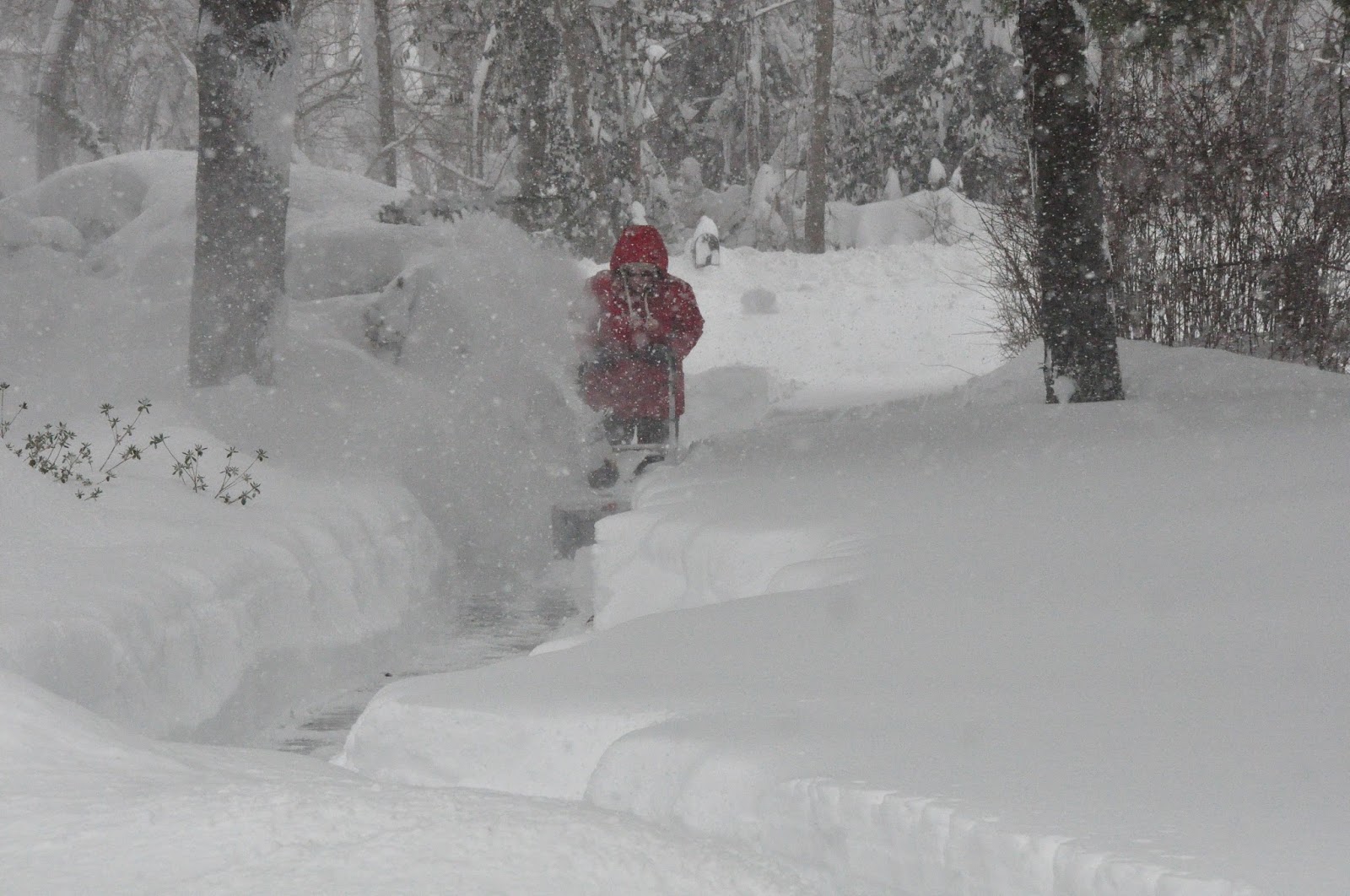
There will be no Saturday Serendipity this week in favor of memorializing in a few shots of what we have experienced here in northern Virginia.  The first photo above is, believe it or not, our four vehicles.

It is still coming down here steadily and has been all day.

Sadly, our new Toro snowblower, refused to start yesterday so we could get on top of this winter gift. We are 50 miles west of DC and tucked up against the Blue Ridge Mountains, so we almost always get more snow than DC.

I have caught something that may or may not be norovirus.  I am too weak to lend anything but nominal assistance.  Molly did a path through the driveway yesterday as our Toro snowblower would not start using the handpull or the electric start, so we took the blower into the kitchen for over night to warm her up.  That did the trick this morning and Molly used her on the entire driveway.


And then there is this photo of the roof on our attached garage.  Good thing we had new roof put on just a couple of years ago!


And finally, here is El Toro resting in our kitchen to prepare for another clean up tomorrow. A bit of advice . . .  having a model with an electric start is well worth the relatively low additional cost. We would have been lost if all we had was the mower-like handpull.


Amazingly, we have lost no power . . . yet.

Molly is a genuine hero!  ;-)

_ _ _ _ _ _ _ _ _ _ _ _ _ _ _ 

All photos by the author.

Copyright 2016, John D. Tew
_ _ _ _ _ _ _ _ _ _ _ _ _ _ _

Tuesday, January 12, 2016

Is This New England Cuisine Specialty Actually A Health Food? (January 12, 2016)


Growing up in New England there were many items of the regional cuisine that were known and appreciated mostly, if not exclusively, by residents of the various New England states: Johnnycakes and clam cakes in Rhode Island; grinders in Connecticut (otherwise known as a sub or hoagy); Boston baked beans, of course; frappes in much of New England were cabinets in Rhode Island (otherwise known as milkshakes); Moxie, the official gentian-flavored soft drink of Maine (although created in Lowell, MA); and many other food items such as lobster rolls, maple syrup and candy, Indian pudding, and New England clam "chowdah" to name just a few. 

And then there is the much loved, but much maligned "fluffernutter" sandwich! 

When I was in elementary school in New Hampshire in the early 1960s it would have been a very unusual lunch period indeed if several student lunch boxes did not contain a fluffernutter. The fluffernutter is so ingrained in New England food culture that the town of Somerville, Massachusetts (where Marshmallow Creme was invented in 1917), holds an annual "What the Fluff?" festival every September. In fact, the Fluffernutter is so embedded in New England culture that it had to eventually become the subject of political maneuvering and proposed legislation. 

In 2006 a Massachusetts State Senator decided that the guilty pleasure of the schoolhouse fluffernutter had to be curbed for the health and welfare of The Bay State children and he proposed legislation to limit the serving of the traditional sandwich by school cafeterias to once a week. Not to be outdone, the State Representative whose district was just south of Lynn, where the key ingredient to fluffernutters is created, introduced a bill to make the fluffernutter the official state sandwich. Both bills failed. And so it goes . . . the traditional and controversial fluffernutter lives on even if not clothed in the glory of being an official state sandwich in a New England state.

Now, for the uninitiated, the regionally famous and traditional fluffernutter was always made with white bread, peanut butter, and a marshmallow creme that was invented in Massachusetts in the early 20th Century. According to Wikipedia, marshmallow fluff was invented by one Archibald Query in Somerville, MA in 1917 and he called it Marshmallow Creme. The earliest published recipe for a peanut butter and marshmallow creme sandwich was during World War I when a woman named Emma Curtis from Melrose, MA (who with her husband Amory invented what they called Snowflake Marshmallow Creme), explained how to make what she called a "Liberty Sandwich."  The Liberty Sandwich used oat or barley bread.

It was not until 1960, however, that an advertising agency came up with the actual term "Fluffernutter." Durkee-Mower Inc. hired a marketing agency to come up with a campaign to market the peanut butter and marshmallow creme sandwich and thus sell more of their Marshmallow Fluff (originally called Toot Sweet Marshmallow Fluff). H. Allen Durkee and Fred Mower bought the recipe of Archibald Query in 1920. In 1960, the agency came up with the name Fluffernutter and today the name is a registered trademark of Durkee-Mower.


As much loved as the New England-born Fluffernutter is, even with its rich history it is also the subject of ridicule and mockery to the point that the term is sometimes used to simply describe an insubstanital thing having little or no value. And as the aborted attempt to legislatively limit its consumption in Massachusetts schools demonstrates, the venerable Fluffernutter has even been attacked as a contributor to childhood obesity!

Recently, it was with some degree of shock that I realized my wife and her sister (who grew up in New Jersey), were not really familiar with the traditional comfort food that is the Fluffernutter. AND I realized that I had not indulged in one in so long that I could not remember the last time I had one. Since these realizations hit while I was assisting my sister-in-law with her move to the Adirondacks, I added "Fluff" to our shopping list. It was no surprise to find that the grocery stores in the North Country of upstate New York (being contiguous to New England states) stocked Fluff in regular and huge sizes -- and so some Fluff was purchased and the Fluffernutter was introduced to a lifelong denizen of the Mid-Atlantic States. And it was good!

Now when I was growing up in New Hampshire and consuming Fluffernutters with some regularity, I never paused to consider what the Fluff in Fluffernutter was made of -- or the nutritional/caloric value of the sweet ingredient in the sandwich. But as an adult in snack food, nutrition-conscious, America I happened to glance at the Nutrition Facts label on the jar of Fluff while in the grocery store and I was delighted to discover that Fluff is actually a health food!  Who knew??

You are doubtful? Unbelieving? Derisive?  Well, look at the fact sheet on this marvelous combination of corn syrup, sugar, dried egg whites, and vanillin and judge for yourself.


The standard 2 tablespoon serving of Fluff has a mere 40 calories and none of them come from fat or trans fat. There is a minimal amount of sodium (5mg) compared to many foods we eat in great quantities today, and there are only 6 grams of sugar per serving in the total 10 grams of carbohydrates Moreover, Fluff is not a significant source of cholesterol. 

Compare Fluff to the other required ingredient in a Fluffernutter -- let's say the "natural" peanut butter of a national brand that, "Has to be good with a name like . . . "  The standard 2 tablespoon serving of this delicious peanut butter weighs in at 200 calories with 16 grams of total fat of which 2.5 grams is saturated fat. And, the peanut butter brings you 105 mg of sodium with 6 grams of total carbohydrates of which 1 gram is sugar.

If you match your 2 tablespoons of peanut butter with the popular strawberry jam from the same famous national brand to make yourself a PB&J instead of a Fluffernutter, what do you get? Well, even though you will get the same zero fat as Fluff, you will consume 100 calories and 26 grams of total carbohydrates -- of which 24 grams will be sugar.  The jam will not give you any significant sodium.

There you have it, a classic New England food specialty is actually a modern health food.  So make room for Fluff in the pantry, abandon your blind reliance on the good ol' PB&J, and branch out with introduction of the New England health alternative -- the one and only Fluffernutter!

_ _ _ _ _ _ _ _ _ _ _ _ _ _ _ _

All photos of a jar of Marshmallow Fluff by the author.

See, http://smuckers.com/(S(cp0m3j451sg5qz45o5isg0nf))/products/peanut-butter/natural-peanut-butter/natural-creamy-peanut-butter-65 for a link to the nutritional facts for Smucker's Natural Creamy Peanut Butter.

See, http://smuckers.com/products/fruit-spreads/jam/strawberry-jam-1353 for a link to the nutritional information for Smucker's Strawberry Jam.

Fluffernutter is a registered trademark of Durkee-Mower Inc.
_ _ _ _ _ _ _ _ _ _ _ _ _ _ _ 

Copyright 2016, John D. Tew
_ _ _ _ _ _ _ _ _ _ _ _ _ _ _

Saturday, January 9, 2016

Saturday Serendipity (January 9, 2016)


Saturday Serendipity returns this week with my first post of 2016. Having been traveling for the holidays and now concentrating on the long, painful process of reorganizing over 29,000 genealogy photos and document images (see December 19, 2015 post), I have had to put aside my blogging to get on top of things. Now that I am back to some genealogy and history reading, here are just a few recommended reads for this weekend.

1. The Weekly Genealogist of NEHGS highlighted a piece at the Smithsonian National Museum of American History blog that summarized the top ten most read of its blog posts in 2015. 

2.  Do you have any ancestors or relatives who lived in Barnstable, Massachusetts? Check out this article about the steps being taken to preserve record books and documents going back almost 400 years.  Once the material is restored and digitized, they will be available via computer; until then the documents are still available to the public as long as a town employee is present during handling.

3.  As genealogists, we are always open to locating new sources for potentially useful and informative data to better inform our genealogies. The rapidly moving era of digitization brings us new research sources almost daily. Rebecca Onion at The Vault posted two pieces about digital history projects that "dazzled" her this past year.  You can see the second of her two posts and you can get a link to her initial post here. As a teaser of what you can find, how about an online Reno, Nevada divorce history or a mapping of the occupation by the Army after Appomatox and during Reconstruction?

4.  The last issue of NGS Magazine for 2015 (Vol. 41, Number 4, Oct. -- Dec. 2015) was largely devoted to writing. As Editor Darcie Hind Posz put it, the goal of the issue was to "offer inspiration, practical tools, and new approaches to genealogical writing." The issue is worth the time it takes to read it.

5.  And speaking of NGS, UpFront With NGS blog had a recent post about the status and future of microfilm records.  You can read the brief post and get links to more extensive pieces here.

6.  And finally, here is an interesting video that only lasts 1 minute. It shows via a morphing map of the U.S. how our population grew and moved from the first census in 1790 through the most recent census in 2010.

_ _ _ _ _ _ _ _ _ _ _ _ _ _ _ 

Copyright 2016, John D. Tew
_ _ _ _ _ _ _ _ _ _ _ _ _ _ _