Sunday, December 20, 2020

Into Real Pages -- A New Blog-to-Book Producer (December 20, 2020)


Ever since I began blogging I have worried about how best to preserve for my sons–and now my granddaughters–the fruits of my family history blogging efforts.  As I first mentioned in a blog post dated February 20, 2015 (three years into my blogging), having the blog exist only out there on the web was not enough to ensure its survival for descendants now and into the future.  At the time, I had discovered Blurb as a source for easily converting my blog into book form.  I used Blurb for two volumes of a 12" x 12" hardback reproduction of my blog into book form.  But then Blurb stopped supporting the Blogger format for "slurping" the blog content into a book project that allowed me to review and edit the content and look to best reproduce the blog in book form.  And all the time I continued posting on the blog so that content was growing, but capture was at a standstill.  This past year I decided I had to do something about finding a replacement blog-to-book provider.

After a few hours of research online this past summer, I finally settled on a new to me provider known as "Into Real Pages" and as a result I have completed a trial run of another book form volume of The Prism covering three months of posts from 2013 (that is how far behind I am).  The book arrived this week and I must say I am pretty happy with it despite some limitations.

The new Volume 3 has a completely different look than the first two volumes, because duplicating the same look I had with Blurb proved to be either too difficult or not possible (as you can see by comparing the look below with that from the original post on my blog-to-book project back in February 2015).


Into Real Pages currently supports Blogger and other popular blog formats (and I hope they continue to do so).  For this first trial run, I captured quite easily and quickly three months worth of blog posts from 2013 and they were automatically put into a book project form for me to review and edit.  The editing ability is broad and easy, but there are some limitations imposed in the present form of the Into Real Pages application (which is done entirely on the web).  I found the editing pretty easy and frankly less involved and time consuming than Blurb was.  The photos were better placed with Into Real Pages and required much less moving and correcting.  Like Blurb, Into Real Pages does not provide an exact duplication of the layout and look of the blog posts themselves, but it does a very good job of laying out the essentials with a minimal need for correction, moving, and editing.

Here is an inside look at one of the blog posts that can be compared to the original Blogger post of August 19, 2013


This also illustrates one of the limitations of Into Real Pages that is apparently a feature of their application and cannot be changed.  Each post has its original title converted into a full-page title page, which is superfluous inasmuch as it duplicates the blog post title that appears automatically as the heading of the post immediately beside the created title page.  Not only is this redundant, it increases the pages in the book and thus the cost.  This is something I hope Into Real Pages changes or at least gives the creator control over.

There are a couple of features of Into Real Pages that I like more than Blurb.  Foremost of the improved features is the table of contents at the front of the book (called "Chapter index" by Into Real Pages).  This allows one to find exactly what page a particular blog post starts on, whereas Blurb just placed the posts in the chronological order in which they were "slurped" into the project (unless one edited the order).  Blurb provided page numbers within the book, but no way to have a table of contents or an index to find exactly where a post could be turned to--they simply followed in chronological order throughout the book and some posts ran into more than one or two pages.  With Into Real Pages one can see the actual page where a particular post begins and turn directly to it.  It makes the book more user friendly in my opinion.


There is another feature that I think I like, but it is really not necessary and, as with the redundant subject pages, serves to make the book length longer and somewhat more costly–but it does look nice and is growing on me, which is good because as I understand it the feature is imposed and cannot be deleted.  [That having been said though, I have to confess this was a first attempt with Into Real Pages and I might not be fully versed in the use of the application and what things can be changed.]. The feature is the "Great Photo Wall" that occupies the first two pages of the book.  The Photo Wall reproduces in thumbnail form photos from the blog posts in a collage of color as you can see below.  Some of the photos get cut off in odd places decapitating some statues and people, but the full photos can be seen at the Post themselves.


In summary, I am happy with this trial run of Into Real Pages and I hope they continue to support Blogger for some time to come so that I can catch up with converting my existing posts into book form.

So what about the cost?

As with Blurb I wanted to produce my blog books in the 12" x 12" square, hardback format on high quality glossy paper.  The cost runs about $1.15 per page for the first 80 pages in that format.  Each additional page above the first 80 is $0.60.  Into Real Pages does offer discounts periodically--especially if you purchase more than one copy at a time.  As you would expect, there was a holiday discount offered and my savings on three copies of a 174-page book was a total of $102.34.  Each 174-page book came out to a net cost of $137.75 (with tax and shipping from Germany included), which works out to an actual cost of 77 cents per page.  The books are not cheap, but the quality is good and when viewed as a very long term investment in preserving family history, the cost is then "amortized" over many years and I think the books are worth the cost and effort.  I see no reason why minimal care of the books would not allow them to be enjoyed by generations of descendants.

*     *     *     *

Readers might have noticed that there have been no Saturday Serendipity posts for the last couple of weeks.  That feature of Filiopietism Prism is now on an indefinite hiatus.  The time devoted to the reading and writing that went into each Saturday Serendipity post is being reallocated to a push to catch up with converting the accumulated posts on this blog into book form.

*     *     *     *

_ _ _ _ _ _ _ _ _ _ _ _ _ _ _ _

Copyright 2020, John D. Tew
_ _ _ _ _ _ _ _ _ _ _ _ _ _ _ _


Friday, December 18, 2020

Amends (December 18, 2020)


[Bernard A. Handler is my brother-in-law (husband of my sister Susan).  He has been a guest blogger here before https://filiopietismprism.blogspot.com/2014/12/searching-for-ernest-by-bernard-handler.html.  In fact, back in 2014 he was the first ever guest blogger here at The Prism.  This time Bernie shares a short story about a Christmas long ago and his mother's yearning in a time of Depression hardship to provide a little holiday cheer in her family's home.  It is a story of understanding and amends that captures the spirit of the season.]


Ellen Forbes circa 1930 with possible nephew and dog


Amends

by Bernard A. Handler


My grandmother Sarah Clay Forbes departed Leicester, England in 1908 with six kids in tow. She and her children sailed from Liverpool on a ship named the Hartford and arrived in Philadelphia to join her husband, Thomas Albert Forbes, a loom operator. The family settled in Germantown and grew: six more children, and in 1921 a seventh, my mother Ellen, the baby of thirteen. 


During the Great Depression the family managed - a rented roof overhead, food to eat, clean clothes to wear, but little else. As the Christmas of ’33 approached Ellen decided to find a Christmas tree for her family’s home on Bringhurst Street. One evening with the help of a friend, she snuck onto the grounds of the First United Methodist Church on the corner of Germantown Avenue and High Street and cut down a tree which she and her accomplice carried back to the Forbes’ household. 


First United Methodist Church of Germantown (circa 1905)

Six years later Ellen became the first in her family to graduate from high school, Germantown High, right across the street from the church, the same school from which my sister Beryl and I graduated in ’65 and ’67 respectively. Ellen first told me the story of the stolen tree several years before she died in 2009. My initial reaction was, “Geez Mom, a church. Why a church?” Her sheepish reply, “They had quite a few so I didn’t think they’d miss one.


Certainly Esther, the current United Methodist Interim Office Administrator, nor the present pastor, Bob, missed the tree since they were unaware of Ellen’s 87-year-old transgression until Monday, July 27, 2020.  On that date, my wife Susan and I stopped by the church office to make a voluntary donation to the church and to confess Ellen’s crime–perhaps in hope of absolution.  Judging by the looks on the faces of Esther and Bob, and their positive reception of the background story, Ellen can rest in peace. 


Ellen Forbes Handler, thank you for guiding me with love and teaching me that through forgiveness peace is found.


_ _ _ _ _ _ _ _ _ _ _ _ _ _ _ _


Copyright 2020, Bernard A. Handler

Published with the permissionof the author.

_ _ _ _ _ _ _ _ _ _ _ _ _ _ _ _


Thursday, December 10, 2020

Success, But Support Still Needed: An UPDATE on the United States Cadet Nurse Corps Service Recognition Act


Cadet Nurse Corps recruitment poster


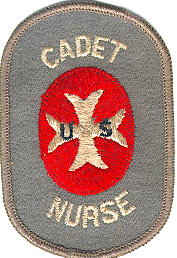
Cadet Nurse Corps badge


Cadet Nurse Corps pledge pin


Since the post of December 5th,  many citizens, former Cadet Nurses, and family members of deceased Cadet Nurses contacted the office of Senate Minority Leader, Charles E. Schumer [D-NY], and as a result he added his name as co-sponsor of the United States Cadet Nurse Corps Service Recognition Act on December 7th–making him the 36th co-sponsor.  Such a significant and meaningful date to have signed on (Pearl Harobor Day). Thank you Senator Schumer!

The strong bipartisan support for this long overdue recognition of Cadet Nurse Corps members for their vital service during WWII is now at just over half of the U.S. Senate.  More needs to be done, however.  There are still some states whose senators have not added their names to the support for this Act.  Perhaps they have not been informed about the nature of the Act, that it is virtually a no-cost piece of legislation, and that it provides long delayed and overlooked recognition to a female medical workforce that answered the call of the country in a time of serious need and thereby saved the country's health care system from total collapse.  By the oft used terms of "heroic" service today, they were heroines of their time!

The following 26 states count one or both of their senators among the co-sponsors of the United States Cadet Nurse Corps Service Recognition Act:  New York, Maine, Montana, Massachusetts, Connecticut, New Jersey, New Hampshire, Oregon, Alabama, Maryland, Michigan, Pennsylvania, Minnesota, Delaware, Wisconsin, Arizona, Texas, Kansas, Ohio, North Dakota, Washington, Arkansas, Vermont, West Virginia, Nevada, and Louisiana.  This means that barely half the states have had one or both of their senators weigh in on support for minimal recognition of these heroines of WWII.  

The senators from the other 24 states need help to do the right thing and add their support for this important Act.  They may be very busy during the close of this Congress and have not been reminded of the pending Act, so we need to remind them and urge them to step up and join their colleagues from both parties to remedy this oversight.  These are the 24 unrepresented states on the co-sponsorship of the United States Cadet Nurse Corps Service Recognition Act:  Rhode Island, North Carolina, South Carolina, Georgia, Florida, Mississippi, Kentucky, Tennessee, Illinois, Oklahoma, Nebraska, South Dakota, Wyoming, Idaho, California, Alaska, Colorado, Utah, Virginia, New Mexico, Indiana, Iowa, and Hawaii.

Lest we forget the vital role nurses play in our health care system, we have a very stark reminder playing out before our very eyes on a daily basis during this COVID pandemic.  Nurses are sacrificing their family life and sometimes even their very lives to keep our health care system functioning and to prevent even more catastrophic loss of life than we have experienced so far.  During WWII about 124,000 young women stepped up in a similar way to save lives and to keep our health care system from imploding.  They were role models for generations of nurses and the nurses today are their direct descendants.  We owe the Cadet Nurses the minimal recognition and honor that the United States Cadet Nurse Corps Service Recognition Act would provide.

Perhaps some of your ancestors or relatives were attended to and cared for by a Cadet Nurse.  If you believe those young nurses then and our nurses today provide an invaluable service that should be recognized (no matter how late), then please reach out to the U.S. Senators in the unrepresented states listed above and urge them to sign on to S997 as co-sponsors right away.  It is an easy, but so meaningful way to say thank you to all the nurses that have touched your lives!   
_ _ _ _ _ _ _ _ _ _ _ _ _ _ _ _

Copyright 2020, John D. Tew
_ _ _ _ _ _ _ _ _ _ _ _ _ _ _ _ 

Saturday, December 5, 2020

A Long Overdue Recognition of Service--And How YOU Can Help (December 5, 2020)


Today is a special post in lieu of the usual Saturday Serendipity, but it does include this recommended read

As the COVID 19 pandemic rages throughout our country and our medical system is being stressed to the point of near collapse in many areas of the nation, it is worth pausing to consider that in some respects we have been here before.  Just as 102 years ago we suffered at least 675,000 American deaths due to a virulent strain of influenza that challenged scientists, physicians, and nurses, we are again finding ourselves relying on front-line medical professionals to battle a deadly disease–and they are being stretched and stressed to the breaking point.

We have been here before.  Beginning 77 years ago and lasting for just over five years the nation called on a segment of its population (entirely women) to come to the aid of the country during a medical care crisis.  It was not due to a deadly virus or influenza at that time, but rather to a severe loss of medical personnel as the result of World War Two.  After the entry of the U.S. into the war following the bombing of Pearl Harbor, doctors and nurses were swept up into service in the war effort in such numbers that the majority of nurses were no longer available to serve the domestic medical needs of the country.  As a result, a call was put out to increase dramatically and quickly the number of nurses so that the medical needs of the country could be met while the home front worked to supply and support the military efforts overseas during the war.

Beginning in 1943 and lasting until the end of 1948, about 124,000 women answered the nation's call and pledged to devote essential nursing services for the duration of WWII.  These women joined the newly enacted uniformed service known as the U.S. Cadet Nurse Corps and received training, financial assistance, and a small allowance in exchange for their open ended pledge of service.  It is estimated that Cadet Nurses were soon providing 80% of the critically needed nursing care in civilian, government, and military hospitals during WWII and they have been credited with preventing a total collapse of the U.S. health care system as the war raged on.

But then–and for the last seven-plus decades–the members of the Cadet Nurse Corps have never really received the recognition, appreciation, and honor that they surely earned and deserved.  In this respect, the Cadet Nurse Corps was overlooked or forgotten in a similar way that the members of the U.S. Merchant Marine serving to supply our military during WWII were treated for several decades until they were finally recognized by the Merchant Marine Decorations and Medals Act of 1988.  [See this previous post on that subject here on The Prism.]

Presently there is pending before the U.S. Senate and the U.S. House of Representatives two identical bills to rectify this long overdue recognition of the service of the members of the U.S. Cadet Nurse Corps.  IF these bills are passed and included in the year-end omnibus package, the surviving members of the Cadet Nurse Corps and the families of those deceased Cadet Nurses can finally receive the virtually no-cost recognition and honors they so admirably earned and deserve.  The text of the Senate bill, S997 is as follows .  .  .


If you believe the nurses of the uniformed U.S. Cadet Nurse Corps deserve this belated recognition for their contributions to the nation's war efforts and the preservation of the country's health care system during WWII, please contact Minority Leader Chuck Schumer ASAP to voice your support and request inclusion in the omnibus package.  Your support can be noted by calling his Washington office at (202)224-6542 or his New York Office at (631)753-0978.  It is easy and you can just leave a message if the office is not answering live calls due to the pandemic.  It will take less than two minutes to accomplish.  

Very few of the 124,000 Cadet Nurse Corps members are still with us and those few are running out of time to receive and see the long overdue recognition the bills provide and that they so richly deserve.

*    *     *     *  

In the interest of full disclosure .  .  .

Shirley Carpenter in her Cadet Nurse Uniform circa 1944


My mother, who will turn 94 this coming March, was a Cadet Nurse.  On July 22, 2016, I blogged about her service in the Cadet Nurse Corps and you can read that post here.


AND FINALLY, as we daily see the agonizingly hard work and emotional toil and stress that our front-line COVID nurses and doctors are dealing with as this pandemic accelerates, it is not too early to suggest that we begin now to consider how their hard work and sacrifice to assure their communities and nation can weather and recover from this horrific pandemic can be recognized and honored.  Just as the current bills to recognize and honor the members of the Cadet Nurse Corps allow for the design and production of a medal to award to the Cadet Nurses, we should make sure that a truly grateful nation takes similar steps to honor the doctors, nurses, and other front-line health care workers who served to get us through this pandemic.  It is the least we can do.  They should not have to wait decades to receive some manifest token of appreciation and gratitude from a thankful nation.

 _ _ _ _ _ _ _ _ _ _ _ _ _ _ _ _

Copyright 2020, John D. Tew

_ _ _ _ _ _ _ _ _ _ _ _ _ _ _ _


Saturday, November 21, 2020

Saturday Serendipity (November 21, 2020)


Below are a few suggested reads for your weekend.

1.   Today is the anniversary of the signing of the Mayflower Compact.  Under the Old Style calendar in effect at the time, the Compact was signed on November 21, 1620 as the Mayflower remained anchored in the harbor at is what now Provincetown, Massachusetts.  You can read more about the Pilgrims and the Compact here at the History.com.

2.   If you have ancestors or relatives that served in the U.S. Army, you should be aware of the opening of one of the nation's newest museums.  The National Museum of the U.S. Army opened this month in Fairfax County, Virginia just outside Fort Belvoir.  You can read more about the museum here.

3.   Jacqi Stevens, of A Family Tapestry blog, discusses genealogy volunteerism and has a suggestion for a needed project for anyone who might be looking, as Jacqi puts it, to "give back" in recognition of all the helpful genealogical resources other volunteers have made possible.  Read here Jacqi's post, "Instead of Indexing, Trying Something New." 

4.   Have you ever thought about donating an artifact, document, or other item to a respository?  If so, you should read a recent post, "How to Donate an Item to a Repository" by Marian B. Wood, of Climbing My Family Tree blog. 

5.   There are two items of interest posted this week by James Tanner, of Genealogy's Star blog.  The first is the 5th installment in his series on reading handwritten documents.  The second is a post listing a number of FREE virtual classes, webinars, and videos available from the BYU Family History Library.  You can read the list here.

6.   Have you ever received or inherited a box full of genealogy "stuff?"  Most of us have or will at some point.  So is there some advice–or even a practical process–for dealing with such usually unorganized treasures?  The answer is "yes" and Janine Adams, of Organize Your Family History blog, has written about the challenge and linked to the blog and presentation by Stacy Julian, who first caught Janine's attention on the subject.  You can read Janine's post and get a link to Stacy's presentation and .pdf handout here.  

7.   Finally, if you have been waiting for an opportune moment to obtain books on the Mayflower and the Great Migration, NEHGS/American Ancestor is having a 20% off sale on their Great Migration and Mayflower titles.  You can see the titles available here.  The sale ends November 25th. 

_ _ _ _ _ _ _ _ _ _ _ _ _ _ _ _

Copyright 2020, John D. Tew

_ _ _ _ _ _ _ _ _ _ _ _ _ _ _ _  

Friday, November 20, 2020

Friday Fotos-- A Thank You card from Nora (November 20, 2020)


The older of our two granddaughters, Nora, turned six earlier this month and started kindergarten this year due to her late birthday.  She has been reading for quite a while now and is proud to be using her developing writing skills.  Today we received a "Thank You" card from Nora completely in her own handwriting!  

It is interesting to see that she is already working on her own distinctive handwriting flourish by adding the curlicue to her lowercase "a."  It reminds me that when I was in 1st grade at Streiber Memorial School (now apparently known as Streiber Elementary School) in Chicopee, Massachusetts my teacher criticized my lowercase "i" because of the large dot I placed above, and too close to, the vertical line.  She said they looked like lollipops instead of a proper "i."  This undoubtedly contributed to my abandonment of the use of all cursive writing (except for my signature) and use of lowercase print letters as soon as I was able to get away with it in school.  To this day, I use only uppercase block lettering in everything I write and distinguish upper and lower case only by the size of the letters.

Love the curlicues.  You go Nora!  😍
_ _ _ _ _ _ _ _ _ _ _ _ _ _ _ _

Copyright 2020, John D. Tew
_ _ _ _ _ _ _ _ _ _ _ _ _ _ _ _ 
Saturday, November 14, 2020

Saturday Serendipity (November 14, 2020)


Having just got off a Crowdcast virtual meeting of the Rhode Island Genealogical Society (RIGS) and needing to complete some projects before dark, here are a few suggested reads for this weekend.

1.     National Geographic published an article today by Bill Newcott titled, "400 years on, the Pilgrims get a reality check."  You can access the article here

2.     And speaking of the Pilgrims, this week (Wednesday, November 11–coinciding with Veterans Day) marked the 400th Anniversary of the signing of the Mayflower Compact.  Those with Mayflower ancestry might be interested in reading more about the Compact and can do so by going here, here and here.  

3.   Continuing the Mayflower theme, to commemorate the 400th anniversary of the Mayflower The Weekly Genealogist of American Ancestors/NEHGS announced this week the release of the world's largest Mayflower lineage database.  The database contains the authenticated lineages of all the Mayflower passengers.  You can read more and search the database by going here, but note that you must be a member to access images and transcripts.

4.   James Tanner, of Genealogy's Star blog, posted part 3 of his series on reading handwritten documents. You can read the post here.

5.  I am nowhere near ready to do any writing and publishing of a proof argument relying on DNA, but for those of you who are and are wondering what the process would involve, you can get some insight by going to this piece by Nicole Dyer at Family Locket –"How to Write and Publish a Proof Argument with DNA Evidence."

_ _ _ _ _ _ _ _ _ _ _ _ _ _ _ _ 

Copyright 2020, John D. Tew
_ _ _ _ _ _ _ _ _ _ _ _ _ _ _ _

Tuesday, November 10, 2020

Heather's Honor Roll Project (Veterans Day 2020)---Wallingford, CT World War II Memorial Part 5---close up panel photos


Yesterday, November 9, 2020, I contributed to the 2020 call for additions to the Honor Roll project of Heather Rojo.  My contribution for Veterans Day 2020 continued the process of transcribing the hundreds of men and women from the Wallingford, Connecticut area who served their country during World War II (my father being among them).

As the above photograph of the WW II memorial on the grounds of the Wallingford Town Hall illustrates, there are seven panels each with triple columns of the names of those who served. Starting with my 2016 Veterans Day post, many, but nowhere near all of the names listed on the first panel, were transcribed. The surnames are in alphabetical order across the entire seven panels. 

My post of November 10th, 2016 transcribed and listed all the names on the first panel from George C. Abbott, Jr. to Joseph E. Buza -- 244 names altogether. My Memorial Day 2017 post listed all the surnames  that begin with C through E -- 298 names in all.   For Veterans Day November 8, 2017, I transcribed an additional 317 surnames covering those beginning with F through I and the Veterans Day 2019 post added 242 more names covering surnames beginning with J through L.  Yesterday 395 surnames covering all of those beginning with M through Q were transcribed and posted.  

In keeping with my intent to also post close-ups of the panels showing all the names I have transcribed and listed, this is the post of panel close-ups to provide photographs of all the surnames that begin with M through Q. This is the process that will be followed for the remaining panels over time in order to keep the transcription posts to a manageable size.  The transcribed names will be posted first and photographs of the panel close-ups covering the posted names will follow shortly thereafter so that those who want to have an actual image of the memorial and the name of ancestors or relatives can take them from these posted photographs.

In early posts of the panel close-ups I think I neglected to mention that some of the names have a star/asterisk preceding the inscribed name.  This means that the starred person gave the ultimate sacrifice and died in service during the war.

I am very indebted to my cousin, Bruce Marquardt of Wallingford, for so willingly photographing the panels in close-up for me after my efforts to do so failed.  Thank you Bruce!

The following six panel close-ups cover the M to Q surnames on the Wallingford WWII memorial from Allen A. Macfarlane through Carroll C. Quimby.  Please note that in order to be sure all names were photographed, the photos overlap and some names are therefore shown more than once.  The repeated names can thus be used to orient the precise order of the names from Macfarlane to Quimby.  The alphabetical order flows down the first column and then up to the top of the second column and finally up to the top of third column on each of the panels. 

The surnames starting with M begin with Allen A. Macfarlane in the third column of the first close-up Photo No. 1 below and continue down that third column through to Photo 4 and the name Marvic H. McCune.  The surnames starting with M then continue in the first column of Photo 5 with the name James J. McDonough and follow down that column to the name Ralph B. Munson on Photo 9.  The M surnames then move to column two on Photo 10 beginning with the name John J. Murphy until the M surnames are completed eight names down that column and end with Thaddeus J. Myers

Photo 1

Photo 2

Photo 3

Photo 4

Photo 5

Photo 6

Photo 7

Photo 8

Photo 9

The N surnames begin in the second column of Photo No. 5 above with the name Frank P. Naczi and continue down the second column in Photos 5 - 8 before ending in the second column of Photo No. 8 with the name William Nyiri.  Surnames starting with O begin in the second column of Photo No. 8 with the name Edward J. O'Connell and continue down the second column in Photos 8 - 9 before ending in the second column of Photo No. 9 at the name Adrian Ouwerkerk.  The P surnames begin in that same column in Photo 9 with the name Pasquale J. Pacelli and then begin again in column three of Photo 5 with the name Albert F. Padley, Jr.  The P surnames continue in the third column of Photos 5 - 9 until they end in column three of Photo 9 with the name John Popovich before resuming in column one of Photo 10 immediately below. 

Photo 10

Photo 11

Finally, the surnames beginning with P and Q are completed in the first columns of Photos 10 and 11 above ending with the name Carroll C. Quimby in Photo 11.
_ _ _ _ _ _ _ _ _ _ _ _ _ _ _ 

All close-up photographs of the panels of the WWII memorial are by Bruce Marquardt of Wallingford, Connecticut.

Photo of the entire memorial is by the author.
_ _ _ _ _ _ _ _ _ _ _ _ _ _ _

Copyright 2020, John D. Tew
_ _ _ _ _ _ _ _ _ _ _ _ _ _ _