Showing posts with label New Hampshire -- Salem Depot. Show all posts

Thursday, May 28, 2020

A Possible Silver Lining to the COVID Pandemic: Can a 20th Century Cultural Phenomenon Make a Comeback for Us and Our Descendants?


One of my earliest memories–going back to about 1956–is waking to the sound of an explosion and then seeing fire everywhere completely consuming buildings while a man led a horse and wagon past the conflagration. I sat there frightened, but mesmerized, until my parents realized I was awake and watching the commotion. When I was much older I realized that what had awakened me and what I had watched was the scene of the burning of Atlanta from the movie Gone With The Wind (depicted above).

Back in 1956 I had only seen black and white TV at my grandparents home on a small, round screen and what I was watching was huge and in living color.  It was what must have been one of my earliest, if not my very first, drive-in movie experience.  It took place at the Shipyard Drive-in located in Providence, RI.  [The drive-in lot actually sat on the border between Providence and Cranston.  The screen was located in Cranston.]  Throughout my childhood, drive-in movie trips were one of the true highlights of every summer for me and my siblings.  Sadly, today Rhode Island only has two active drive-ins: the Rustic Tri-View Drive-in on Rte. 146 South in North Smithfiled, and Misquamicut Drive-in located in Westerly.  

But now, in this era of the COVID pandemic, drive-in movie theaters just might be making a longed for comeback due to the ability to be outdoors and to easily practice social distancing in the comfort and privacy of one's own vehicle!!  ðŸ˜ŠðŸ’–¹  


According to Wikipedia, "After 1945 rising car ownership and suburban and rural population led to a boom in drive-in theaters, with hundreds being opened each year.  More couples were reunited and having children, resulting in the 'Baby Boom,' and more cars were being purchased following the end of wartime fuel rationing.  By 1951, the number of drive-in movie theaters in the United States had increased from its 1947 total of 155 to 4,151."  Today there are 300 or fewer opreating drive-in movie theaters in the U.S.–but based on recent news reports, that might be changing as summer arrives and families are looking for safe family entertainment that avoids the close contact of indoor movie theaters.  I for one am thrilled with this possibility.  I have mused with my wife for maybe a decade now that new technology should have been able to bring back the drive-in theaters, but my hopes and enthusiasm never saw the resurgence I fondly wish our grandchildren could experience.  It appears that a possible silver lining of this otherwise horrific and destructive pandemic could be the revitalization of the family drive-in experience!

The history of the drive-in is an interesting one, and, as a cultural phenomenon of the middle of the 20th century, it is a worthy subject for inclusion in any detailed treatment of a family genealogy/history covering the actual experiences of ancestors.

The history of the drive-in seems to have begun in New Mexico.  Wikipedia states that the first "partial drive-in theater" was the Theatre de Guadalupe that opened in Las Cruces, New Mexico on April 23, 1915 and closed in July 1916.  The partial drive-in Theatre de Guadalupe experience was described as follows: "Seven hundred people may be comfortably seated in the auditorium. Automobile entrances and places for 40 or more cars within the theater grounds and in-line position to see the pictures and witness all performances on the stage is a feature of the place that will please car owners."  In the 1920s a "drive-in" opened that allowed cars to park bumper-to-bumper in downtown Comanche, Texas and see the screening of silent films from their cars.  And later, so-called "outdoor movies" (where patrons sat in rows of seats outdoors to watch movies) were tried.

An outdoor seated movie theater in Iran during the 1960s
The drive-in movie theater as most of us came to know it was patented in New Jersey on May 16, 1933 by Richard M. Hollingshead, Jr.  His family operated the R.M. Hollingshead Corp. chemical plant in Camden, NJ.  It was in 1932 that young Mr. Hollingshead (he was 32 years old) conducted what today would be called "proof of concept" tests of his idea for a true drive-in movie theater.  He conducted his tests in the driveway of his home at 212 Thomas Ave. in Riverton, NJ.  He nailed a screen to trees in his backyard and then placed a 1928 Kodak projector on the hood of his car.  He put a radio behind the screen and ran tests for different sound levels with his car windows up and with them down.  During his driveway tests, he also placed blocks under cars in the driveway to figure out the size and spacing of ramps so that all cars could have a clear view of the screen.  When he was satisfied his idea could work, he applied for a patent and opened his drive-in on Admiral Wilson Boulevard in Pennsauken, NJ on June 6, 1933.  The sound was not projected from individual speaker boxes at each car, but rather from a single tower and resulted in a sound delay for patrons parked in the back.  The viewing screen was  40 x 50 ft. and the drive-in theater had room for 400 cars², but after three years he sold the theater and its infrastructure was moved to Union, NJ. 

As my siblings and I grew older, the family moved around New England following my father's various promotions and transfers within the Sears store management program.  When we lived in Chicopee, Massachusetts, we would go to the AirLine Drive-in that was just minutes from the first home my parents owned.  The drive-in was named after the fact that it was located directly in the path of a runway for Westover Air base.  It was the summer evening trips to the Air-Line that gave rise to what we children came to identify as the telltale signs a drive-in trip was in the offing–there was a an attempt on the part of our parents to secretly pop a huge paper shopping bag full of popcorn and the large insulated picnic jug would appear to be filled with the special drive-in juice mixture made from cans of frozen lemonade and Welch's dark grapejuice.  It was also at the Air-Line that I first remember what became a staple of a child's drive-in experience–the playground!  I suspect now that the playground was not only to occupy kids while it was too light out to show the movie, but also (especially for a double feature) it was to hopefully wear out the kids so the adults could enjoy what was often the second, more mature feature in the peace and quite of sleeping children.  [Many young kids going to a drive-in back then arrived in pajamas and it was not unusual for pajama-clad kids to populate the playground before the movie started. There was a very helpful countdown to the movie time that was principally an animated advertisement of all the goodies available at the concession stand until the movie started and during intermission.]  


When our family moved in about 1958 from Chicopee to what was then called Salem Depot, NH, our local drive-in was the Ole Rock Drive-in just a couple of miles down the road from the new housing development where we lived.  It was located right across from the famous Rockingham Race Track (which was called out in the movie "The Sting").  It was on the main road going from Salem into Lawrence, Massachusetts and it was not far from the Coca-Cola bottling plant in Salem back in the era where Coke came in little green glass bottles that were not disposable and were washed and reused.


The horse racing track at the top of the photo and The Ole Rock Drive-in at bottom center.

Our next move was from Salem to Concord, NH, the state capital.  In Concord the drive-in was across the Merrimack River from where our homes in Concord were located.  The Concord Drive-in was east of the river up toward what was called "the Heights" where the airport was located.  The drive-in was down Blackhill Rd. across from the airport and down closer to the river.  During this time I was in late elementary school and the first year of what was then junior high school and could not drive–so drive-in trips were still very much a summer family event with a huge bag of popcorn and a jug of drive-in juice, but not many sleeping kids in PJs anymore. 


In 1965, our family (my parents, four kids, and a dog) moved from Concord, NH to Cinnaminson, NJ, a small residential town across the Delaware River from northeast Philadelphia.  This was our first experience of living outside New England and in the penumbra of one of the largest cities in the country–but there were still active drive-ins in the immediate area.  It was in NJ in the late 60s that I received my driver's license and a new era of relationship with the American drive-in began.

Before I was licensed to drive, my younger siblings and I would still look forward to a family outing to a drive-in, but the playground was more for my youngest brother who was nine years my junior.  The concession stand now held more interest, but the bag of popcorn and the jug of drive-in juice were still required items for a true drive-in event.  We did not realize then that we actually lived very close to the home in neighboring Riverton where young Mr. Hollingshead invented the modern drive-in.  In fact, his former home was just a few minutes walk from the school my sister and I attended–Cinnaminson Jr. Sr. High School.  [Years later the older of my two younger brothers and his family lived in Riverton and still later his daughter and her family lived in Riverton.]  

The first drive-in I remember the family going to in New Jersey was just a few miles north up Route 130, the highway that divided Cinnaminson east and west.  It was the Super 130 Drive-in located in Edgewater Park, NJ.


At age seventeen I was able to get a driver's license in NJ and the the drive-in was a wonderful summer substitute for dates at a movie theater during colder seasons.  The drive-in that stands out most from that time is the Circle Drive-in on the border of Moorestown and Mapleshade, NJ, neighboring towns to Cinnaminson.  It sat at Routes 38 and 73 very near the Moorestown Mall on Rte. 38 and Matlack's Dairy Bar on the opposite side of the drive-in lot.  The Circle Drive-in no longer exists, but it is where I met my future wife.


And then there was the Pennsauken Drive-in on Rte. 73 just across the Delaware River from Philadelphia.  It opened in the 1950s and was closed by about 1985.  I recall seeing the movie Cool Hand Luke, starring Paul Newman, there.  Below are two aerial views of the Pennsauken Drive-in taken from different angles.  In the top photo the screen is at the top of the photo in the trees and in the lower photo the screen is at the bottom.


By the 1970s the decline and disappearance of the American drive-in was well underway.  It was not until the late 1980s after Molly and I were married with two young sons that the hankering for another drive-in experience took hold.  I especially wanted our sons to know what a drive-in movie theater was  before they completely disappeared.  It was about this time that we discovered an active drive-in along the route we took each summer to get to the Adirondacks from our home in northwestern Virginia.  On Rte. 15 in Pennsylvania just south of Harrisburg in a little town called Dillsburg we passed Haar's Drive-in.  We could not stop to take in a show, but it incentivized me to try to find a drive-in closer to our home than the 90-mile, nearly 2 hour drive to Dillsburg.  Haar's Drive-in opened in June 1953 and remains an active drive-in to this day (although in more recent years they also operate an auction on the site).  Movies are shown at Haar's Drive-in from April through September.


Another active drive-in is the one I found that was much closer to our home in Virginia.  The Dalke Family Theatre in Stephens City, VA was just off Interstate 81 in the Shenandoah Valley and only about 35 miles from our home.  We first went to the Dalke Family Theatre drive-in when our sons were about 6 and 8 years old.  We popped a huge bag of popcorn and made a jug of the drive-in lemonade/grapejuice mix and thoroughly enjoyed a summer evening at a real drive-in.  The boys were at the playground until it darkened enough for the movie to start and still remember the experience.  Later we took the boys and their cousins to the drive-in so they could have the experience and I hope they still recall the event fondly.


The Family Theatre, as it is now known, opened in 1957 and has a capacity of 490 cars.  A second screen was added in 1989.  The drive-in is still active as of today.


All of this trip down memory lane leads to what I hope will be an unintended silver lining resulting from this COVID pandemic.  We have two granddaughters 3 and 5 years old now and they have never experienced a drive-in movie.  There is at least one active drive-in within a reasonable driving distance of us here in central New Jersey.  As a family summer activity, a trip to  a drive-in could be a new and fun activity for young children who have no idea what a drive-in movie theater is.  At least initially, the outing would seem to have low or even very low risk when the children are confined to a vehicle with immediate family members and mixing with unknown children and other parents at the playground is eliminated.  Packing food and drink from home can avoid the concession stand/snack bar and the mingling with others outside the family, but be aware  that some drive-ins add a surcharge to the admission fee if food from outside is brought–they rely heavily on concessions sales to remain viable and open.  Use of the rest rooms could pose a risk, but otherwise being in the family vehicle with close family members only, enjoying the outside, and observing social distancing could be a safe family activity.³  

If the drive-in is rediscovered as a fun family event during this warm weather phase of the pandemic, then we can hope that one of the great cultural experiences of generations coming of age in the last century, combined perhaps with ingenious use of new technology, can give rise to a resurgence of the drive-in movie theater!  For many of us from the 20th century–and for those of the millennial generation (Generation Y) and the Zoomers of Generation Z who get to at least exerience a drive-in movie once–such a resurgence could be a silver lining to what has otherwise been a frightful, life altering period in the history of our lives, our country, and our world.  Here's hoping!   
_ _ _ _ _ _ _ _ _ _ _ _ _ _ _ _

¹  Recent reports on the news indicate that the pandemic is also giving rise to the return of long-departed services.  For example, the milkman returneth in some parts of the country.  Wade's in Connecticut has put two trucks on the road to make home deliveries of its milk–something that had not been done for decades.  Many boomers might recall the days of the insulated aluminum boxes on the porch where milk was placed by the milkman during his home deliveries.  I can also clearly recall my grandparents getting fresh vegetables and fruits as well as fish and some meats delivered to their home in Cumberlnd, RI when I was a young boy in the 1950s.  Just recently our daughter-in-law discovered a seafood company in Asbury Park, NJ that delivers fresh, dayboat caught seafood to homes in NJ.  See,  https://local-130-seafood-online-shop.myshopify.com.  We also have been getting direct-to-home delivieries of freshly baked, warm loaves of wonderful breads now.  See, https://hoophousenj.com/breadbasket.  Perhaps home delivery of fresh fruit & vegetables might be coming back too??
²  Hollingshead advertised his new drive-in using the slogan, "The whole family is welcome, regardless of how noisy the children are."
³   See, https://www.npr.org/sections/health-shots/2020/05/23/861325631/from-camping-to-dining-out-heres-how-experts-rate-the-risks-of-14-summer-activit where experts rank various summer activites by risk level and advise on ways to alter any risks.  With respect to a drive-in experience note the general risk and advice on use of public restrooms. 

Most of the photos above came from the website cinematreasures.org, which was praised by Roger Ebert as "the ultimate web site about movie theaters."  The website has a section devoted to drive-in theaters and includes a list of active drive-ins.  You can explore this wonderful website at the provided link.  Enter "Drive-ins" in the search bar at the top of the page and then select "United States" to see drive-ins in the U.S.

Another site with information about drive-ins is DriveInMovie.com, which is billed as "The Internet's Oldest Drive-In Movie Resource."  It lists drive-ins by state and provides historical information, but fewer photos than Cinema Treasures.

And then there is the drive-in blog by "tine263" on Wordpress.  "Tine" is a drive-in aficionado and writes of her adventures in visiting drive-in movie theaters–whether open or closed.  She lives in South Jersey and mainly explores the bordering states within easy driving distance of her home.  Her blog contains wonderful photos and stories of her adventures and it is worth a visit to Drive-in Theater Adventures. 

A good history of the drive-in movie theater is found at Wikipedia.  The photo of the outdoor seated movie theater is taken from a link at that site.
_ _ _ _ _ _ _ _ _ _ _ _ _ _ _ _

Copyright 2020, John D. Tew

_ _ _ _ _ _ _ _ _ _ _ _ _ _ _ _

Wednesday, November 12, 2014

Nearly Wordless Wednesday (November 12, 2014) -- Guarding The Shovels In Salem Depot, NH


There is a well-known story in our family about the time my father came home from work one evening when we lived in Salem Depot, NH. He was the Assistant Manager at the Sears store in Lawrence, Massachusetts just across the state line from Salem. It had been snowing all day and he anticipated that he was going to have to shovel snow from the steps, walks and driveway when he got home. When he went to shovel after grabbing some supper, he found that the shovels were nowhere to be found.  Apparently, there was telltale evidence that some shoveling had taken place earlier in the day in the back yard where we often made snow forts or cleared an area to spray with water and create a rink -- but the snow had gone on all day and the shovels could not be seen. My father rousted the three kids and we had to don our snow gear and trudge around the backyard feeling for the shovels that were buried in the late-accumulated snow.

For years I have teased my siblings (particularly my brother Peter), by insisting that he/they were to blame and that I was innocent in the Great Disappearing Shovels caper. 

Recently a trove of lost snapshots was discovered and amongst the treasures is the proof of my innocence!

As can easily be seen in the photograph above (taken in January 1960), all three shovels were in the front yard of our home on Joseph Road in Salem Depot. My maternal grandfather's Packard is at the head of the driveway and the family Scotsman station wagon is sitting behind it. I am leaning against the lamp post holding one shovel and guarding the other two that can be seen leaning against the Packard and the Scotsman respectively. The depth of the snow can be gauged by the untouched accumulation on top of the Packard.

I take this snapshot as belated proof positive that not only was I not involved in the loss of the shovels in the back yard under late arriving snowfall -- I was actually trying to make the shovels easily available and noticeable for my father!  

Case closed.            

_ _ _ _ _ _ _ _ _ _ _ _ _ _ _

January 1960 snapshot from the family collection.
_ _ _ _ _ _ _ _ _ _ _ _ _ _ _

Copyright 2014, John D. Tew
_ _ _ _ _ _ _ _ _ _ _ _ _ _ _ 

Thursday, July 10, 2014

Another Genealogy Tool -- And A Proposed Project Idea To "Pay It Forward" (July 10, 2014)


Recently the United States Geological Survey (USGS) made over 178,000 of its survey maps available in a searchable on-line database called the "Historical Topographic Map Explorer." This tool makes available survey maps that go back as far as 1884 and they are searchable by city and town!  [See an item in this week's forthcoming "Saturday Serendipity" for more information and links.

This post is about my visit to the Historical Topographic Map Explorer to see how it works.  In doing so, I fell into a little memory game that strikes me as a potential basis for targeted neighborhood map projects that could become ways for those of us here today to "pay it forward" by providing useful information that might otherwise be easily lost to future generations and future genealogists.  I describe the memory game and project idea below -- with an example.

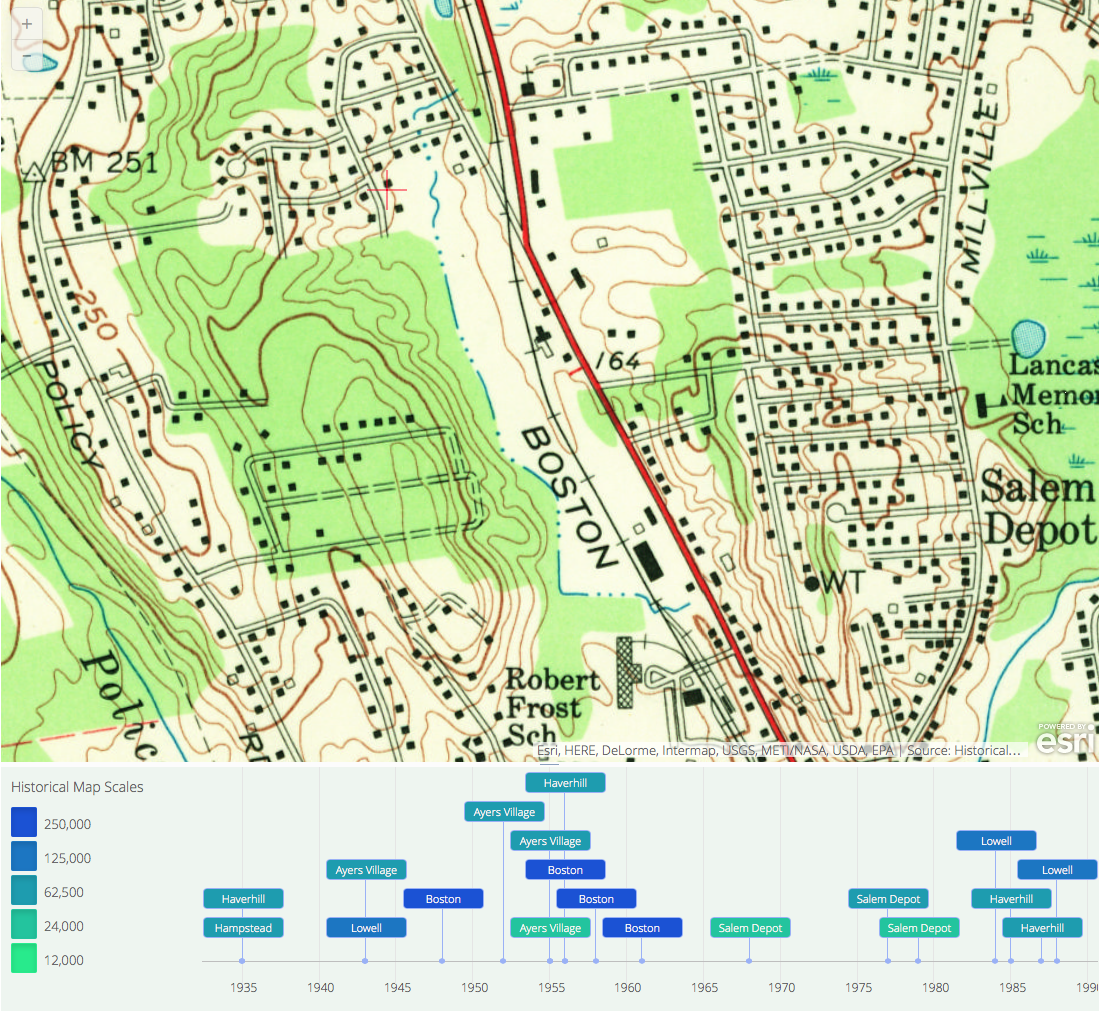
The screen shot shown above is a portion of a 1967 survey map for the town of Salem Depot, New Hampshire taken from a search for Salem Depot in the Historical Topographic Map Explorer.  I chose Salem Depot out of curiosity because it was a small developing community on the border of Lawrence, Massachusetts in the early 60s and it was not a large city that one would expect to definitely be covered in this database.  I also chose it because my family lived in Salem Depot for about three years (1960-1962).

As a glance at the map section above indicates,  Salem Depot was a residential community in the early 1960s that was expanding with new home developments.  One of the principal home builders at the time was a family-owned construction company that named the streets in its development by using the first names of children and other family members.  We lived in that development at 18 Joseph Road, Salem Depot, NH pictured here.

18 Joseph Rd., Salem, NH (March 2010)

In looking at the 1967 survey map of Salem Depot, I found myself tracing the streets to our development and to the little square that represented our home in 1960 - 1962.  I then found myself digging deep to recall the names of some, but far from all, of the other families that lived in our neighborhood.  I pointed to the squares of their homes and suddenly struck on the idea that probably none of those families are still there and that few if any people in that neighborhood today could say who lived in those houses some 50 or more years ago -- but isn't that information that could be of interest and of use to people researching family histories?  And so the idea for a neighborhood map project took hold and I produced for myself the map shown immediately below.


The annotated map above color codes my identification of our home on Joseph Road and the homes of the Sullivan, Patten, Conner, Grimes and Perrant families who also lived in the neighborhood in the early 1960s.  

_ _ _ _ _ _ _ _ _ _ _ _ _ _ _

Screen shot of a portion of the 1967 USGS survey map for Salem Depot, NH obtained using the USGS Historical Topographic Map Explorer.

Photograph of 18 Joseph Rd., Salem, NH by the author (March 2010).

Annotated USGS map identifying family homes circa 1960 - 1962 by the author. 

_ _ _ _ _ _ _ _ _ _ _ _ _ _ _

Copyright 2014, John D. Tew
_ _ _ _ _ _ _ _ _ _ _ _ _ _ _    


Tuesday, March 4, 2014

Travel Tuesday: A Genealogy Trip To New Hampshire (March 4, 2014)

In the early spring of 2010 I went on a a genealogy trip to New England to visit some cousins, do some research in Newport, RI, and to visit the homes my family lived in while we were in New Hampshire in the early 1960s. 

My family moved to Salem, New Hampshire in 1959 when it was still called Salem Depot. Three years later we moved to the state capital, Concord.  This brief post is about my visit after almost 50 years to the home, the school, and a special place I recall from our days in Salem Depot.

With apologies to Thomas Wolfe* . . . "You Can Go Home Again -- But It Will Sure Look Different!"

We moved to Salem Depot from Chicopee, Massachusetts when my father was transferred from the Sears store in Holyoke to the Sears store in Lawrence, Massachusetts (just across the state line from Salem Depot).  My father became the Assistant Manager of the Lawrence Sears store.  

When we moved to New Hampshire, I was in the 2nd grade.  My parents bought a white Cape Cod style house in a new and growing development that had lots of kids in the neighborhood and lots of woods just beyond our back yard.  The woods seemed at first to stretch forever, but within weeks I knew every inch of the scores of acres.  New friends and I created trails and forts through the ferns and undergrowth of the mixed pine and hardwood forest.

Our house at 18 Joseph Rd. almost 50 years later. (2010)

Today all the woods are gone and houses sit where I used to climb trees and build forts.  My favorite climbing tree is nowhere to be seen.  The house is no longer white and it seems to have shrunk, but the landscaping is more mature and a hedge of forsythia exists that was never there in the early 60s. The road to the left of the house is completed with more houses and the hill that I recall the road heading up is now just a gentle incline lined with homes and tall trees. I suspect there are no more party lines in the neighborhood and all the overhead lines carry internet and cable connections as well as individual phone lines to each home.  

The school I attended was Mary A. Fisk Elementary, which as I recall had grades 1 through 4 and possibly Kindergarten. There was a Smokey Bear Club organized in the school after a visit from a Park Ranger to emphasize fire safety. Our playground was a sloping grassy field to one side of the school and beyond the school there was not much development as the school sat at the outer edge of what was Salem Depot proper.

Mary A. Fisk School in late March 2010.

Today Fisk School is expanded in size and the grassy sloped play field is gone under a section of the school that never existed before. What was the main entrance to the school in the early sixties (shown above as the rectangular brick arch at the far end of the cream-colored section of the building) looks little used today and the walkway to the doors and the bushes appear merely ornamental. The school now has grades 1 - 5, but no Kindergarten. Instead of a Smokey Bear Club, they have an After-School Enrichment Program called "Zumbatronic Club" and they are in the process of renovating a gymnasium they never had in 1959.  

On the other side of the woods behind our home on Joseph Rd. in Salem Depot was a reservoir called Canobie Lake. On the Lake was a very special place called Canobie Lake Park. It was an amusement Park that was first opened in 1902. In its early days, the Park had flower gardens and "promenades," but in later years it added a dancehall theater, swimming pool, roller coaster, and other rides. On summer Saturday nights in the early 60s I could lay on the top bunk in my room and watch the weekly fireworks rise above the woods behind our house.  What I did not know at the time was that my grandfather used to visit Canobie Lake Park in and around 1912 - 1913 when he was a student at Phillips Academy in Andover, Massachusetts. He died before we moved to Salem and so I never got to hear him recall for us his visits and exploits at Canobie Lake in its earliest years. [My father and the rest of the family only found out about this amazing coincidence when I came across mentions of Canobie Lake Park while transcribing my grandfather's 1913 Line A Day diary about two years ago.] 

Postcard of Canobie Lake Park Dance Pavilion (1910)

Canobie Lake Park rides circa 1950s - 1960s 

Canobie Lake Park is still there in Salem going strong at over 110 years old. It looks more modern and has added ever more extreme and challenging thrill rides. I do not know if they still have weekly Saturday night fireworks during the summer or if it still attracts entertainment names like Duke Ellington, Frank Sinatra, Sonny & Cher or Aerosmith as it did in years past, but "Just For Fun" it still provides laughter, thrills and memories for added generations of the young and young at heart!

A Canobie Lake Park entrance (2010)
_ _ _ _ _ _ _ _ _ _ _ _ _ _ _ 

All photographs by the author (2010).  The two vintage postcard images from eBay.

* Thomas Wolfe is the author of "You Can't Go Home Again" (1940). As the main character, George Webber, states at the climax of the novel, "You can't go back home to your family, back home to your childhood . . . back home to a young man's dreams of glory and of fame . . . back home to places in the country, back home to the old forms and systems of things which once seemed everlasting but which are changing all the time -- back home to the escapes of Time and Memory."

For more information about Canobie Lake Park, see http://en.wikipedia.org/wiki/Canobie_Lake_Park

_ _ _ _ _ _ _ _ _ _ _ _ _ _ _ 

Copyright 2014, John D. Tew
_ _ _ _ _ _ _ _ _ _ _ _ _ _ _

Sunday, June 16, 2013

A Father's Day Gift to My Dad (June 16, 2013)

The submitted photograph of my father taken at the wedding of his granddaughter Molly (July 2009)

On June 13th I received an email from The Washington Post inviting me to submit for consideration a personal story about my father to run (if selected) on washingtonpost.com  as part of a Father's Day feature.  The theme or prompt for submissions was “What’s a story that makes you proud of your Dad?”  The submission format included some basic information about authors, a request for a description of the father being written about, a space to provide the story itself, a place to submit a photograph of the subject, and a concluding inquiry, “How has this story shaped your opinion of your Dad?  How has it shaped you?”  There was no stated limit on length for submissions and in fact the format stated at one point, “Don’t worry about rambling; the more detailed the better.”

I knew immediately and exactly the story I wanted to finally commit to writing.  AND, I thought if by some wild chance the story were selected for use, it would make a nice Father’s Day gift to my 90-year-old father.

I submitted my story on June 13th and received a thank you for the submission.  My story was not selected for use today, but you can see and read those that were selected here.  Since my story was not selected for publication, that now leaves me free to share the story here and offer it as a Father’s Day gift to my father! 


HAPPY FATHER’S DAY, DAD!! 


What’s a story that makes you proud of your Dad?

When I was about 10 years old, we were living in what was then called Salem Depot, NH. It was on the border with Lawrence, Massachusetts. My father was the Operating Superintendent/Assistant Manager of the Sears store in Lawrence and he worked long hours and often on weekends and evenings. We lived in a fairly new development in Salem in the second house my parents had ever owned -- a four-bedroom Cape Cod with four children between ages 1 and 10 and a dog.

My mother was a Registered Nurse who still worked part-time to supplement the family income and because she loved the work (and probably the break from four kids and a dog). My father had his hands full pursuing his career, being the principal support for a young family, and trying to assist around the home so my mother could also keep her hand in her nursing career. The last thing my father needed was an irritating incident that made no sense; but kids being kids, we supplied them on a regular basis -- and I provided my share.

One day (and this was in the days of party-line telephones), I answered our phone when the woman next door was calling for my mother -- who I am sure must have been working at the hospital in Lawrence. I explained the situation politely, but somewhat shyly in the way a 10-year-old boy would do.  She asked me to give my mother the message that she had called. I agreed. She said thank you. And then, just before I hung up (not knowing of course who might be listening on the party line), the rascal in me took hold for no reason other than an innocent desire to flip the usual response. There was absolutely no malice or hurt intended because I knew and liked this lady who lived across the street and who had young children also. Without thinking -- or actually thinking I was probably making a joke of some kind -- I closed the brief conversation and her polite ending with an easy, lighthearted, "You're not welcome." And then I quickly went back to whatever I had been doing without a second thought or a care.

A day or so later, my mother and the lady next door must have connected to chat and of course my flippant response to her was revealed. My mother was an equal opportunity disciplinarian in the household and things of that nature were not simply left to my father; but as I recall it, the incident was not discussed until my father got home from work, we had supper and my siblings went on to watch a little television.

I was called into conference with both parents and the phone call content was accurately revealed as though there had been a transcript made of it.  BUT, since I had intended no harm and actually thought I was being somewhat humorous in setting the usual polite phone ending on its head, I did not realize the misdemeanor I had committed. And I think my parents quickly understood that I was simply young and impish and had intended no harm by my words.

Spanking was so rare in our household that I am hard pressed to even recall more than a handful of such incidents -- and these days they are actually the subject of much fun and laughter when they are recalled at family gatherings. The telephone incident, I am proud to say, never became one of those rare spankings. It became something much more. Something that I have often thought back on and have related to my own sons and others.

My father said softly, "Come with me. We're going for a little walk." We went outside and eased down the driveway as my father very slowly and gently explained that what I had said to our neighbor was wrong. It was not funny. She was a nice lady and a friend to my mother and she especially deserved polite responses from my siblings and me. We talked it over for a minute or two until I think my father thought I understood and would not do such a thing again. I thought that was the end of it and that I was on my way back into the house to watch TV with my siblings.  But then my father said that there was only one thing left to do and then we could forget it ever happened. I thought it might be one of those very rare spankings, but he said, "YOU need to go next door and apologize to her. I'll walk to the yard with you, but you have to go up, knock on the door and apologize to her. Tell her you are sorry, you did not intend to hurt her feelings or to be mean to her . . . and tell her it will never happen again." I froze because I was a ten-year-old boy and did not speak to many adults outside of my parents and teachers at school.  I actually wished he had decided to spank me instead.

It was an agonizingly long walk across the narrow residential street and a very lonely walk up to the front door as my father stood back at the border of the yard with the street. I was petrified and looked back at him several times in the short walk hoping he would give me a reprieve or at least accompany me at the last minute, but he stood there slowly waving me on. It seemed to take an eternity before the door was answered by our neighbor despite my almost audible prayer that there please be no one home. I rushed through my eyes-averting apology as our neighbor listened. I think she even tried to suppress a small smile as I glanced up once or twice (just to see if she was listening and what her reaction was) and saw her looking past me to my father out at the yard's edge.

When the deed was finally over and I walked back toward my father, I saw him smiling slightly past me toward the front door and then I heard it close slowly behind me. My father put his arm around my shoulder and we walked back home. Not another word was said about the incident or the apology that I recall -- and my father has never been a man at a loss for words or one who was incapable of making the same point in several different ways!

How has this story shaped your opinion of your Dad?  How has it shaped you?

I think at ten years old I was just beginning to understand that my father had a lot of responsibility both at work and in the family and that my foolish incident with the adult neighbor next door was an unnecessary intrusion on the little time he had to relax at home. But he did not treat it as a crime needing swift and simple punishment. He recognized it for what he made it into -- and that surely took him more time than some quick punishment. He saw an opportunity to teach, not punish, and he made it into a lesson -- one I have recalled for the last 51 years. It made me realize that my father could be patient and be a teacher -- and that being a father was no easy thing!

_ _ _ _ _ _ _ _ _ _ _ _ _ _ _ 

Copyright 2013, John D. Tew
_ _ _ _ _ _ _ _ _ _ _ _ _ _ _