Showing posts with label Friday Fotos. Show all posts

Friday, November 20, 2020

Friday Fotos-- A Thank You card from Nora (November 20, 2020)


The older of our two granddaughters, Nora, turned six earlier this month and started kindergarten this year due to her late birthday.  She has been reading for quite a while now and is proud to be using her developing writing skills.  Today we received a "Thank You" card from Nora completely in her own handwriting!  

It is interesting to see that she is already working on her own distinctive handwriting flourish by adding the curlicue to her lowercase "a."  It reminds me that when I was in 1st grade at Streiber Memorial School (now apparently known as Streiber Elementary School) in Chicopee, Massachusetts my teacher criticized my lowercase "i" because of the large dot I placed above, and too close to, the vertical line.  She said they looked like lollipops instead of a proper "i."  This undoubtedly contributed to my abandonment of the use of all cursive writing (except for my signature) and use of lowercase print letters as soon as I was able to get away with it in school.  To this day, I use only uppercase block lettering in everything I write and distinguish upper and lower case only by the size of the letters.

Love the curlicues.  You go Nora!  😍
_ _ _ _ _ _ _ _ _ _ _ _ _ _ _ _

Copyright 2020, John D. Tew
_ _ _ _ _ _ _ _ _ _ _ _ _ _ _ _ 

Friday, July 10, 2020

Friday Fotos (July 10, 2020)


My paternal grandfather, Arnold G. Tew, Sr., was a member of various organizations and among them was the Kiwanis Club of Woonsocket, RI, which completed its organization on May 17, 1917.  He was also a member of the Woonsocket, R.I. Lodge No. 850, Benevolent and Protective Order of Elks.  One of his B.P.O.E. membership cards was recently brought to light from a box of miscellaneous materials saved by my late father.

As advised in the lower right corner of the membership card, the stated member's home address should appear on the reverse side of the card-- and indeed it does.


_ _ _ _ _ _ _ _ _ _ _ _ _ _ _ _

All images are from the original membership card in the personal collection of the author.
_ _ _ _ _ _ _ _ _ _ _ _ _ _ _ _

Copyright 2020, John D. Tew
_ _ _ _ _ _ _ _ _ _ _ _ _ _ _ _

Friday, April 10, 2020

Friday Fotos (April 10, 2020)


At one time, and until sometime in the 1980s or thereabouts, Sears Roebuck and Co. was the largest retailer in the United States, but we all know by now that those glory days for Sears are long gone.

Sears has a particular connection to my family beyond the near ubiquity of its famous catalogs back in the day.  My father's adult career after WWII and service in the United States Merchant Marine was with Sears Roebuck and Co. for decades.  He began as a management trainee in Norwich, Connecticut in May 1953 and worked his way up to Assistant Manager in Sears stores in Connecticut, Massachusetts, and New Hampshire before being transferred down to the Territorial Office staff (Eastern Territory Traffic Department) in Philadelphia in 1965.  My father retired from Sears in 1981. 

As the above images show, at one time Sears made refunds for under a dollar by issuing the refund checks depicted above.  These were recently unearthed from a box of miscellaneous items collected and left behind by my late father.  According to some sources, these refund checks were issued in the 1940s and were phased out by the early 1960s.  I suspect these were probably from about 1957-1960, but I have no way of knowing for sure.  As stated on the face of the checks, the funds could be used by applying them to future orders with Sears, or they could be cashed at Sears stores or at any bank.  They were bearer paper and so anyone possessing them could use or cash them.  In other words, as bearer paper, they could be used almost like cash–but only for less than a dollar.  Notice that they are not dated and they have no "stale" or expiration date.  I wonder what I could get at Sears for 93 cents today?  I guess I would first have to fill the car's gas tank and then see if I could find a Sears store!  😀

_ _ _ _ _ _ _ _ _ _ _ _ _ _ _ _

Copyright 2020, John D. Tew
_ _ _ _ _ _ _ _ _ _ _ _ _ _ _ _     

Friday, December 20, 2019

Friday Fotos (December 20, 2019)

     'Tis the season for visits to and from Santa Claus.

     Yesterday, Molly and I attended the Christmas sing-and-dance-along at our granddaughters' pre-school and, of course, Santa came to visit.  He gave each child a wrapped present and posed for a photo.  Most of the visits went beautifully with a little chat between the jolly old gent and the child on his lap.  But as every parent will recall, some of these meet-and-greets with photo opportunities (no matter how well prepared and planned for) "Gang oft a-gley" as Robert Burns put it.  Some of the children were having none of the strange man in red with the large white beard.

     This made me recall the very first newspaper appearance by my younger sister and me.  It was in the 1950s in Holyoke, Massachusetts.  I was about 4 and my sister was 14 months younger.  One of us, however, was having none of the photo session with Santa Claus.  As shown below, a newspaper photograpgher caught the ephemeral moment in time and it was published (even though our last name was mispelled somehow).


_ _ _ _ _ _ _ _ _ _ _ _ _ _ _ _

Copyright 2019, John D. Tew

_ _ _ _ _ _ _ _ _ _ _ _ _ _ _ _ _

Friday, November 8, 2019

A Goose Here, A Goose There Every Day, But Never The Elusive Moose! -- Friday Fotos (November 8, 2019)


In the early 1970s, Molly's parents bought a lakeside Adirondack "camp"[1] out Mt. Whitney Rd. on Lake Placid.  They had the camp for just over three decades.  Our sons went up there every summer from the year each was born until the early 2000s when the camp was donated to Cornell University (where both of Molly's parents attended undergraduate and/or graduate school).

Molly's parents' camp on Lake Placid


The Adirondack Park in upstate New York is a gem of protected nature and wilderness.  It encompasses about a third of New York State's total land mass. [2]  It is unique within the United States.  The Park was created by the state legislature in 1892 and now comprises about 9,375 square miles (six-million acres) of northern woodlands and lakes.  This means the Park is about the size of the state of Vermont and it is three times the size of Yellowstone National Park in Wyoming; in fact it is larger in size than Yellowstone, Everglades, Glacier, and Grand Canyon National Park combined!  The park is a combination of both public and private land and more than half of its land mass is privately owned.  About 45% of the land has been designated as "forever wild" in the New York state constitution.  The private land is committed to 105 towns and villages, farms, businesses, etc.  The year round population in the Park is around 130,000 and another 200,000 seasonal residents arrive in the summer.  About 10 million people visit the Adirondack Park each year and unlike national parks there are no entrance toll booths and no fees for entering the Park.

The Adirondack Park -- especially in the forever wild areas and in areas that have not been over developed with camps -- has a wide variety of wildlife.  Over the years we have seen deer, coyotes, beavers, otters, eagles, black bears, a Great Horned owl, loons, Canada geese, herons, skunks, hawks, and other wildlife too numerous to list here.  But, despite the numerous signs such as the one below warning of moose in the area -- and our constant vigilant eyes when in "moosy areas" -- we never saw a moose in the wild .  .  . until this past August when we visited Molly's sister Kathy who lives in Saranac Lake, NY.

A typical Adirondack roadside sign warning of moose habit ahead


When we arrived in the late afternoon, Kathy announced as soon as we pulled into her driveway that a moose had been sighted numerous times in late afternoon feeding in the shallows on the banks of the Saranc River north of the village.  She had seen it and so we got back into the cars and went off to finally find and see an Adirondack moose.

It is estimated that there are only between 500 and 700 moose in the entire state of New York, but the only population outside the Park is near Lake Desolation south of Great Sacandaga Lake, which is in the southern-most part of the Park.  With that said, sightings of an Adirondack moose are rare and in more than 40 years of trying to see one we failed until this past August!  They are out there, but they are basically very shy and not comfortable near human populations.  Yet, the greatest danger to the moose is collisions with fast-moving vehicles on roads in the Park.  Luckily for us, the five most likely places within the Park to see a moose include the Saranac Lake area (the other four are Vermontville, Limekiln Lake -- Cedar River Road,  and Lake Lila).

We drove slowly up along the Saranac River a couple of times and finally on the last pass Kathy spotted the moose.  We parked and walked back on the shoulder of the road.  I was armed with my digital camera and two telephoto lenses.  Below is the result .  .  . FINALLY!  😊😊
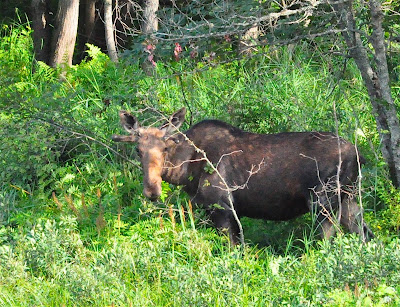


Three views of the real Adirondack moose in the wild finally caught on camera

_ _ _ _ _ _ _ _ _ _ _ _ _ _ _ _ _

Copyright 2019, John D. Tew
_ _ _ _ _ _ _ _ _ _ _ _ _ _ _ _ _

[1]   In the Adirondacks a lakeside or woodland cabin is often referred to as a "camp" rather than a cottage or even a cabin.  The so-called "Great Camps" were not the summer camps for children that we most often think of when talking about camps today.  Instead, a Great Camp was a lakeside, grandiose compound of a main residence and associated cabins for guests to sleep in or for other uses.  One Great Camp even had an outdoor bowling alley with a roof and open sides.  The Great Camps were mostly built in the late 1800s and early 1900s as summer homes for the wealthy to enjoy cooler weather, swimming, boating, fishing and other activities in nature's wilderness areas.  [For more info on Great Camps see, https://en.wikipedia.org/wiki/Great_Camps As the lakes and woods of the Adirondacks developed, just as "a man's home became his castle," the later more modest summer homes on a lake or out in the woods became known as a "camp" rather than a cottage or cabin."

[2]  See https://parks.ny.gov/regions/adirondack/default.aspx

_ _ _ _ _ _ _ _ _ _ _ _ _ _ _ _

Friday, November 1, 2019

Friday Fotos -- Three generations of Cider Fun (November 1, 2019)

Freshly washed drops ready to make into apple cider.

Last weekend we gathered "drops" at a local pick-your-own apple orchard.  Drops are those apples that have dropped from the trees due to wind, wildlife foraging for apples, or people who dislodge apples while apple picking and then do not want to pick up apples that have touched the ground OR have picked a blemished apple and upon realizing it simply drop the apple and pick another unblemished one.  Many drops are perfectly fine apples or merely blemished.  They are excellent apples for making cider because the chopped apples are caught in a filter bag before crushing and therefore stems, leaves, blemished skins, etc., are caught and do not make it into the juice runoff.  More importantly, drops are usually sold at a much lower cost than pick-your-own prices ($3.00/basket as opposed to $1.25/pound at our local orchard).  Many, if not most, apple orchards are happy to have drops cleaned up by hunters who use apples as bait or cider makers who don't mind blemished apples or apples that have been sitting on the ground.

Getting apples for cider with our two granddaughters.

Today Molly and I and our daughter-in-law with our two granddaughters made some cider on a manual press that has been in the family for decades.  Our granddaughters are the third generation to make gallons of homemade, unadulterated autumn apple cider.  It seems it is becoming a Tew family tradition.

The girls crushing the apple mash to make the fresh cider.


In the above photo, apples have been placed in the black hopper at the top center of the press.  The wheel to the left was then turned so that the drum with metal teeth inside the hopper grabs and chops up the apples into a mash that then drops through the bottom of the hopper into the filter bag in the round, wood-slatted basket.  The girls are lowering a long screw that will then press a wooden block inside the basket against the apple mash to squeeze the juice out of the fruit mash and .  .  .  produce the wonderfully fresh apple cider that is shown running out of the collection tray into a stainless steel pot before it is divided into half gallon plastic jugs.


_ _ _ _ _ _ _ _ _ _ _ _ _ _ _ _

All photos by Pamela Winkler Tew.

_ _ _ _ _ _ _ _ _ _ _ _ _ _ _ _ 

Copyright 2019, John D. Tew

_ _ _ _ _ _ _ _ _ _ _ _ _ _ _ _
  

Friday, September 22, 2017

Then and Now: A Mayflower Pilgrimage -- Friday Fotos (September 22, 2017)

L to R: Peter A. Tew, Susan E. Tew, and John D. Tew
at the Pilgrim Memorial bas-relief in Provincetown, Massachusetts (June 1959)

A post today by Heather Rojo of Nutfield Genealogy blog featured a photo essay of her recent visit to Plymouth Plantation. This got me thinking back to a visit Molly and I made to Provincetown, Massachusetts this past March (Molly's first trip to Cape Cod). During the visit we went to the Pilgrim Memorial bas-relief in the park below the Pilgrim Monument & Provincetown Museum (which unfortunately was closed the day we were there). 

The above photo was taken while the family was spending a few weeks on Cape Cod during the summer of 1959 when my father was helping to open the new Hyannis Sears Roebuck store. Either that same summer, or about that time, we also visited Plymouth Rock and Plymouth Plantation. At the time, none of us knew that we children and our mother were actually descendants of Richard Warren, a Mayflower passenger and signer of the Compact. My mother's mother said we were related to the Warrens of Plymouth, but it was not until almost 50 years later that I was able to prove our  descent from Richard Warren through two of his five daughters (and obtain  membership in the General Society of Mayflower Descendants [GSMD] for my mother, my sons and myself).

Fast forward to this past March and Molly kindly took the "Now" photo shown below to bookend the "Then" photo of me and my siblings from 1959. 

 John D. Tew at the Pilgrim Memorial bas-relief in Provincetown, Massachusetts (March 2017)
_ _ _ _ _ _ _ _ _ _ _ _ _ _ _  

Photos from the personal collection of the author.
_ _ _ _ _ _ _ _ _ _ _ _ _ _ _

Copyright 2017, John D. Tew
_ _ _ _ _ _ _ _ _ _ _ _ _ _ _ 

Friday, July 8, 2016

Friday Fotos -- A Poignant 4th of July Photograph (July 8, 2016)


Just a few days after the celebration of Independence Day 2016, the photograph above was discovered among a collection of family photos and snapshots neatly stuffed into shoebox-sized boxes. The photo instantly transported me back to the 4th of July holidays of my boyhood in the days before I attained the double-digit age of ten years.

The photograph shows one of the family gatherings on my mother's side of the family -- the Carpenters of Cumberland, Rhode Island. It was taken on the 4th of July 1961 in the field behind the house where my mother and several generations of her ancestors lived -- 551 High Street, Cumberland, RI. To the left side of the photo is the dark green foliage of a tall tree and folding lawn chairs can be made out in the background under the tree. This is the horse-chestnut tree that grew in the field and was the site of many 4th of July family picnics after the clan had returned from viewing the annual Arnold Mills 4th of July Parade.

It is a real shame that time has degraded what might not have been a very good photograph to begin with -- quality-wise -- but, nonetheless, after looking at the snapshot for a few minutes it dawned on me what an important photo this is in the Carpenter family history.  Not only does it capture a moment in time on one of the family's favorite holiday events, it presents what was certainly the last such family gathering for my maternal grandfather, Everett Shearman Carpenter.

My grandfather is the man second from the right in the damaged portion of the photograph. He is standing with two of his daughters and a daughter-in-law. While the date in the left margin of the snapshot seems to indicate the photo was taken in May 1962, the handwritten "61" and the caption on the reverse side confirms clearly that this was indeed a photo taken at an annual family 4th of July picnic under the horse-chestnut tree. [The reverse side of the photo is shown immediately below the photo itself.] Moreover, I can be absolutely positive that this was a 4th of July family gathering and not some shoehorning of a snapshot to fit one of my favorite childhood memories. 

What makes this photograph so poignant and such an important piece of our family history is that this photo could not have been taken in May 1962 despite what must be the processing date in the margin.  This was the last 4th of July family gathering attended by my grandfather for he died almost exactly six months to the day after this snapshot was taken. He died on January 6, 1962 and -- known or unknown to him -- was probably suffering from cancer as he stood there with his family on a happy, sunny day in July! 

P.S.  For those trying to figure it out . . .  I am the handsome young man with the crew cut in dungarees and a short-sleeved, plaid shirt standing to the left between two pretty girls -- my sister and one of our cousins.                                                              

_ _ _ _ _ _ _ _ _ _ _ _ _ _ _

Photograph scanned from the original in the author's possession.
_ _ _ _ _ _ _ _ _ _ _ _ _ _ _ 
Copyright 2016, John D. Tew
_ _ _ _ _ _ _ _ _ _ _ _ _ _ _


Friday, September 25, 2015

Brown University Class Day 1911 program -- Friday Fotos (September 25, 2015)


The scanned images shown above are of the program for the Brown University Class Day 1911.  It was recently discovered among some family records and artifacts. The original program is a small (5 in. x 6 in.), leather-bound brochure that is held together by a laced and tied leather thong. This made scanning a delicate and difficult process in order to avoid damaging the original family artifact. The page images shown below are not as clear or as straight as I would have liked, but further handling of the document or attempting to unlace the brochure to scan each page individually was not an option.

 The last two pages of the brochure contain a roll of the class members of the Brown University Class of 1911. Among the listed members is my maternal grandfather, Everett Shearman Carpenter, and Ira Winsor Knight, the future husband of my grandfather's sister, Ruth Ann Carpenter.


_ _ _ _ _ _ _ _ _ _ _ _ _ _ _

Images scanned from the original artifact in the possession of the author.
_ _ _ _ _ _ _ _ _ _ _ _ _ _ _

Copyright 2015, John D. Tew
_ _ _ _ _ _ _ _ _ _ _ _ _ _ _ 

Saturday, September 12, 2015

Friday Fotos (September 11, 2015) -- Everett Shearman Carpenter and Two Tew Grandchildren


Everett Shearman Carpenter was born on Washington's birthday (February 22nd) in 1891. He died at age 70 on January 6, 1962.

The above photograph is the only photo that I have ever seen of my maternal grandfather, Everett Carpenter, with just my sister and me.  It was discovered just a day ago amongst a box of old family photographs. The photo is not specifically dated, but is believed to have been taken around 1957 in Cumberland, Rhode Island at the home of my maternal grandparents, Everett and Ruth Carpenter.  I think that the photo is taken of the the three of us sitting on the back tailgate of my parents' Studebaker Scotsman wagon.

_ _ _ _ _ _ _ _ _ _ _ _ _ _ _

Image scanned from the original snapshot in the collection of the author.
_ _ _ _ _ _ _ _ _ _ _ _ _ _ _

Copyright 2015, John D. Tew
_ _ _ _ _ _ _ _ _ _ _ _ _ _ _

Friday, August 28, 2015

Friday Fotos (August 28, 2015) -- Eber Miller's 1841 Pew Rental Receipts


Eber Miller is my 3X great grandfather. He was born in 1805 and married Abby Hunt who was two years younger than he. They lived in Cumberland, RI at 551 High Street and belonged to Christ Church (Episcopal) in Lonsdale, Rhode Island.

Shown above are two paid rental receipts to Eber Miller for the quarterly rental of Pew No. 80 for the periods beginning March 12, 1841 and June 12, 1841 respectively.  The cost for the rental of the pew was $1.43 per quarter or $5.72 per year.

For more about Christ Church in Lonsdale, see the post of February 20, 2014 here.
_ _ _ _ _ _ _ _ _ _ _ _ _ _ _

Scans from the original receipts in the collection of the author.
_ _ _ _ _ _ _ _ _ _ _ _ _ _ _

Copyright 2015, John D. Tew
_ _ _ _ _ _ _ _ _ _ _ _ _ _ _

Friday, July 17, 2015

Friday Fotos (july 17, 2015) -- Esquire Miller's Reward of Merit


Esquire (or Asquare) Miller (1813 - 1841) was the younger brother of my 3x great grandfather, Eber Miller (1805 - 1877).  The Millers owned and lived at 551 High Street in Cumberland, Rhode Island.

Esquire's "Reward of Merit," pictured above, is an example of the paper encouragements given to students back in the 1800s.  These encouragements were not report cards as we think of them today, but rather paper evidence teachers gave to the students (and thus to the parents) to indicate academic performance, "correct deportment," or positive progress in school.  We would call them "positive reinforcements" today.
 _ _ _ _ _ _ _ _ _ _ _ _ _ _ _

Scanned image of the Reward of Merit from the original in the author's collection.
_ _ _ _ _ _ _ _ _ _ _ _ _ _ _

Copyright 2015, John D. Tew
_ _ _ _ _ _ _ _ _ _ _ _ _ _ _

Friday, July 10, 2015

Another Gift From A VERY Kind Cousin -- Friday Fotos (July 10, 2015)


One of the wonderful things about doing genealogy and blogging is the likelihood that one will find previously unknown relatives.  In a little over three years of blogging, I have probably found and had communication with a handful of distant cousins of one degree or another.  A delightful bonus to discovering distant relatives is the ability to exchange genealogical information that one or both parties did not previously know about.  And even better is the ability to exchange ancestor photographs or genealogical artifacts.

Almost a year ago I posted here regarding the extremely kind gift I received of a photograph of my 3x great grandmother, Nancy Mason [Bullock] Carpenter.  

Charlene Butler is a descendant of Abel Bullock (1769 - 1832).  Abel is her 3x great grandfather.  He is my 4x great grandfather.  Abel's daughter, Nancy Mason Bullock (1793 - 1880), is the sister of Charlene's ancestor, Samuel Buffum Bullock (1810 - 1889).  This makes Charlene my very generous 4th cousin 1x removed.

When Charlene realized she had a photograph of my 3x great grandmother, she generously sent me the photograph stating that while Nancy Mason [Bullock] Carpenter was her 2x great aunt, Nancy was my 3x great grandmother -- an ancestor rather than a relative.  The photograph is one of my most treasured family artifacts since it provides the visual image of an ancestor now eight generations back from my granddaughter, Nora Tew! 

Charlene happens to also be descended from a common ancestor in my Tew line.  Charlene is descended from my 8x great grandparents, Richard Tew (1605 - 1673) and his wife Mary [Clarke] Tew (1618 - 1687), through their daughter, Mary Tew (1647 - 1688).  This makes Charlene my 9th cousin 1x removed through my father's Tew line while she is also my 4th cousin 1x removed through my mother's Carpenter line.  A genealogical "two-fer!" 

While Charlene and I have not actually met -- yet -- we have been in fairly regular communication for the last year and her kindness and generosity simply overwhelm me.  Most recently Charlene gifted me with another item (shown above) that she came across while going through materials she inherited from her mother.  It is the original social "calling card" of Ruth A. Miller, also known as Mrs. Samuel Carpenter.  Ruth A. [Miller] Carpenter is my 2x great grandmother on my mother's side.  Nancy Mason [Bullock] Carpenter was her mother-in-law.  And while I now have a photograph of Nancy and of her son Samuel, I have been unable to find anywhere a photograph of Ruth -- but now thanks to my double-cousin Charlene Butler, I have one of Ruth's original calling cards! 

THANK YOU CHARLENE!!  
ONCE AGAIN, YOUR THOUGHTFULNESS AND GENEROSITY ARE OVERWHELMING!
 _ _ _ _ _ _ _ _ _ _ _ _ _ _ _

Scanned image of the Ruth A. [Miller] Carpenter calling card from the original generously gifted to the author by Charlene Butler.
_ _ _ _ _ _ _ _ _ _ _ _ _ _ _

Copyright 2015, John D. Tew
_ _ _ _ _ _ _ _ _ _ _ _ _ _ _

Friday, March 6, 2015

Nora Keeps On Truckin' -- Four Months and Counting. (March 6, 2015)


As I posted on November 3, 2014, our first grandchild was born on that day.  Nora Winkler Tew is our granddaughter and the daughter of Jonathan and Pamela Tew.

Nora is now two days past four months old and she just keeps on truckin'.  She changes every time we see her. She has found her hands and mouth. She is vocalizing loudly to test her voice. She likes time on her stomach and lifts her head with ease. She is on the verge of rolling from her back to her stomach. 

She is a wonder!

Nora's maternal grandparents, Nancy and Jim Winkler, gifted Pamela and Jonathan with the clever age medallions as both a reminder to take regular photos of Nora's growth and as a means of showing her age in photographs.  

Here are photos of Nora at 1, 2, 3 and 4 months old . . . 

Nora at 1 month old.


Here are some additional photos of Nora in all her cuteness taken within the last few weeks.


And finally, the poem/song written for Nora shortly after she was born . . . 


_ _ _ _ _ _ _ _ _ _ _ _ _ _ _

All images from photos in the author's collection.

Poem/song by Nora's Grandpa Tew.  

_ _ _ _ _ _ _ _ _ _ _ _ _ _ _

Copyright 2015, John D. Tew
_ _ _ _ _ _ _ _ _ _ _ _ _ _ _