
It is prudent to always keep in mind an observation made by author Harriet Stryker-Rodda with respect to handwritten documentation. Her observation in the booklet, Understanding Colonial Handwriting[1] is worth quoting in full.
We tend to forget that handwritten documentation, now so highly prized
and used by genealogists, was not prepared for them. Each document had
its own specific purpose. Diaries were kept by individuals who had a special,
personal incentive. Letters were a means of communication. Wills were prepared
to provide for descendants through disposal of property. Deeds were written to
provide legal title to a carefully specified area and recorded to make the deal binding
on all participating parties. Church Records were kept for ecclesiastical
reporting to the church authorities or, in some instances, as surrogate records
for local government. None of these, or any similar genealogically-useful
source material, was prepared for the present-day researcher in family history.
[Emphasis added]
To the list of examples provided by Ms. Stryker-Rodda we could certainly add the decennial federal census, which has as its first and continuing purpose the Constitutionally mandated requirement to apportion representatives in Congress among the states based on a count of the people residing in each state. The count or "enumeration" is to take place every ten years.[2]
It is true that over the years the federal census has been adorned with baubles of additional information beyond the mere tally of indiviuals by gender, age, and civil status that comprised the earliest handwritten enumerations. Over the decades, the census added at times such interesting and useful information as the birth date, occupation, place of birth of the person and the person's parents, citizenship status, immigration dates, naturalization date, property ownership value, whether the home was rented, income, educational attainment, address of the home, etc., to the handwritten enumeration sheets. Each of these data points was added not to assist future genealogists or family historians, but rather to procure data for statistical analysis related to some governmental or social question.
It was fifty-eight years ago that the 1960 census became the first U.S. census to use a self-enumeration form that was sent out to each householder. The so-called "Advance Census Report" was to be completed without the aid of a census employee. Census enumerators were used to personally collect the forms and they then transferred the information from the Advance Reports to permanent FOSDIC ("Film Optical Sensing Device for Input to Computers") forms for computers to calculate the official tabulations. If a household did not complete an Advance Report, or filled it out incorrectly, the enumerator would interview that household and enter answers directly to the permanent forms. So up until the 1960 federal census, enumerators were sent out to collect the necessary data from households in the enumeration districts and the data was entered in the enumerator's handwriting onto the enumeration sheets. The data collected was based on self-report from the householder and was not cross checked against any other official documents such as birth certificates, deeds, marriage records, etc. This obviously left plenty of room for errors on the enumeration sheets due to handwriting illegibility, spelling errors, intentional misinformation being provided (such as ages or immigration dates for example) or misinformation provided based on language difficulties, etc. Many of these sources of error still exist even as the census has become more automated and as technology has improved, and it remains true that census data is a fickle resource for genealogy and family history purposes -- sometimes it is accurate and sometimes it is not.
So, keeping in mind Ms. Stryker-Rodda's gentle admonition that past handwritten documentation was not prepared for future genealogists or family historians, can the federal censuses actually be unintentional purveyors of alternative facts that can badly mislead the unwary genealogist or famiy historian? The answer is yes and the following is a case study in how that can happen . . .
When the 1940 Federal Census was released in April 2012, I eagerly dove into the records to locate my father, his parents, and his siblings. Much to my surprise, it was extremely easy to locate my paternal grandmother, but my grandfather and all three of my grandparents' children were nowhere to be found despite what I thought was a logical, methodical search. The problem was not solved until just a few weeks ago and was due to creative searching by Bill Newcomb, a newly discovered distant relative. The story of the solution and the alternative facts created by the census follows.
I have blogged previously about the families of my paternal grandparents, Arnold G. Tew, Sr. and his wife, Huldah Antonia [Hasselbaum] Tew, but a quick summary of the nuclear families of each of my paternal grandparents is necessary to understand the path of my search through the 1940 Census and to appreciate the bizarre and wildly inaccurate discovery that was revealed by Bill Newcomb's efforts.
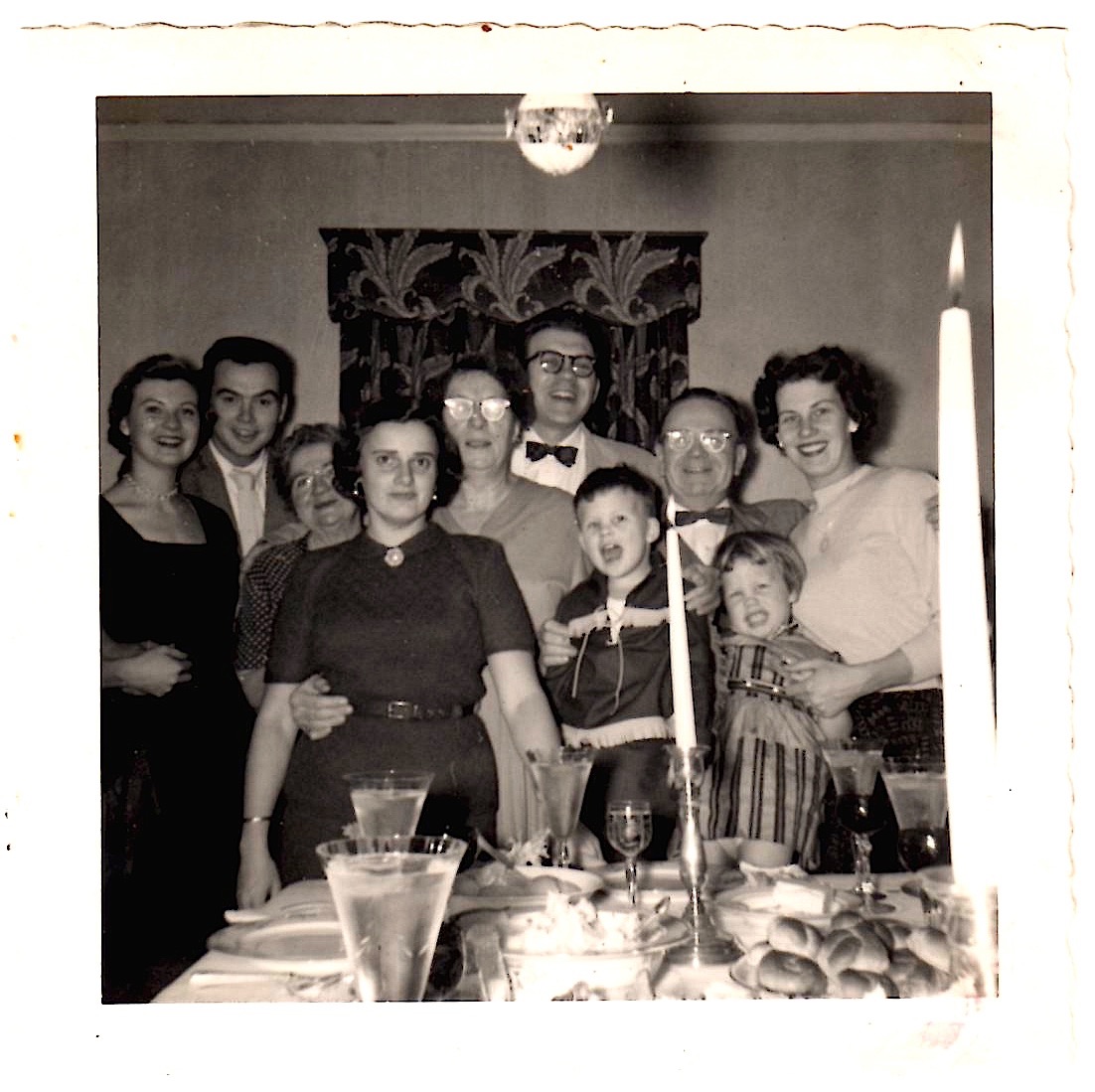
My grandmother was born in Providence, Rhode Island in 1898 as a first generation German-American. She was one of the six children of Anton Hasselbaum (b. 1857 in Windtken, Prussia, d. 1916 in Providence) and his wife, Maria Johanna Richter (b. 1859 in Germany, d. 1948 in Providence). Anton was a successful liquor wholesaler and bottler in Providence. He and Maria had one son Oscar, who lived in Boston in 1940 and who died in 1974. They also had five daughters including my grandmother Huldah (who died in 1983) and her twin sister Josephine (who died in 1990). The other daughters were Mary (who died in 1914 after giving birth to her only child), Olga (who died in 1970), and Helena, the youngest (who died in 1982).
My grandfather was born in Central Falls, Rhode Island in 1896. He was the only one of the four sons of John Andrew Tew (1853 - 1903) and his wife, Margaret "Maggie" Conner (1860 - 1935), to survive past the age of two. John and Maggie's first-born child was my grandfather's sister Edna Lillian Tew (1885 - 1969) who was 11 years old when my grandfather was born. My grandfather's father was killed at age 49 when he was hit by a train on his way to work in Providence. My grandfather was 6 years old when his father died and he was thereafter raised by his mother Maggie and his sister Edna, who was then almost 18 years old.
At the time of the enumeration for the 1940 Census, my grandparents had been married for about 19 years. All three of their children had been born by then: my father, Arnold G. Tew, Jr., was born in November 1922; his brother John was born in October 1926; his sister Priscilla was born in July 1933.
 |
| Wallum Lake Sanitorium (now the Zambarano Hospital) |
By 1940, my grandmother had been diagnosed with tuberculosis and was in the process of undergoing treatment at the sanitorium located at Wallum Lake in Burrillville, Rhode Island. The sanitorium had been built in 1905 on 250 acres to isolate and treat victims of the disease that was then the leading cause of death in Rhode Island. There was considerable social stigma associated with contracting TB until the paths of transmission were better understood (one of the transmission vehicles was the consumption of unpasteurized milk). In the 1940s states began making pasteurization compulsory and better refrigeration also helped reduce contamination from milk. But it was the introduction of antibiotics like penicillin and particularly streptomycin that began the period of truly successful treatment of TB after 1940. Because my grandmother was being treated at Wallum Lake (successfully as it turned out) she was a resident there on June 6, 1940 (enumeration day), and so was easily found in a simple search of the 1940 Federal Census (as shown below).
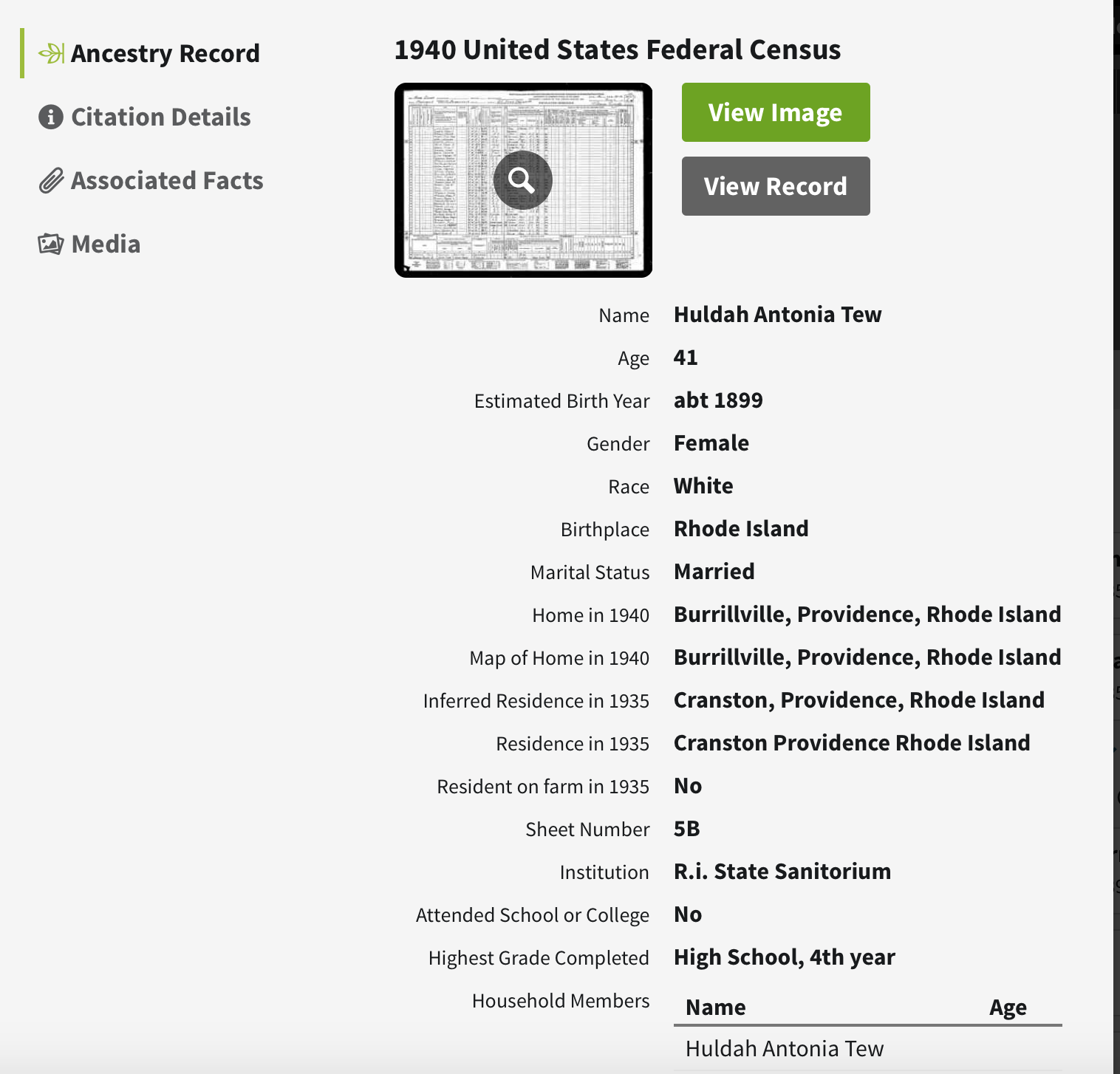 |
| The Ancestry index transcription for Huldah A. Tew in 1940 |
 |
| Full Sheet 5B containing Huldah Antonia Tew (highlighted) |
 |
| Extract of Sheet 5B showing an expanded view of the highlighted line for Huldah Tew |
Enumeration for the 1940 federal census in Rhode Island took place in early to late spring and so this meant that my father was 17 years old at the time, his brother John was 13, and his sister Priscilla was only 6. This also meant that the three siblings were all still in school while their mother was being treated at Wallum Lake and when the census enumeration took place. My grandfather worked at the time for the Ciba[2] chemical company and traveled as a sales representative around New England placing analine dyestuffs with commercial users of dyes. One of the largest users of dyes was the textile industry. Before the advent of synthetic aniline dyes the textile industry had to rely mainly on natural dyestuffs. Since my grandfather had to travel to make a living, he was faced with the dilemma of having three school-age children at home while his wife was being treated in a sanitorium.
I knew that my father's family lived in Woonsocket, RI for many years, but they had moved to Cranston just as my father was entering his senior year of high school. I searched the 1940 census for my grandfather, "Arnold G. Tew" and the three children I knew he had. I searched looking for any hits in Woonsocket or Cranston, but came up empty. I tried many times to find the family with no success until, perplexed, I put the project aside.
When I came back to the project weeks later I had spent some time thinking about why I had so easily found my grandmother, but could not find the rest of the family. As I thought out the problem I remembered my father mentioning a few times that when they lived in Woonsocket they had a "housekeeper." As I thought about it this seemed a little odd because once married, my grandmother never worked outside the home. I also recalled that my grandfather had a vacation cottage at Horseneck Beach in Westport, Massachusetts and there was a photograph that showed my father and his siblings at the cottage. A little more research revealed a handwritten timeline my father made about six or seven years ago. It stated, "17 yrs. old @ Nov. 28th 1939 ~ June 1940 graduated June 1940. 1940 Summer @ Westport. . . Starting Sept. 1940 thru June 1941 at Lyman Hall @ Wallingford." These recollected facts raised new possibilities. . . with my grandmother absent, perhaps my grandfather relied on a housekeeper to be with his children after school and when he had to travel on business overnight. Once school was out, the children could have moved to the summer cottage in Massachusetts for the summer, or, since my grandfather' older sister Edna lived in Wallingford, Connecticut with her husband (and their only child was grown and married by 1938), perhaps the children moved in with their Aunt Edna and were in Wallingford during the census enumeration. I looked for my grandfather and his children in Westport, Massachusetts and in Wallingford, Connecticut, but came up empty again.
It was at this point that I arrived at the conclusion that the family circumstances had necessitated fluid living arrangments while my grandmother was in treatment and my grandfather had to still make a living as a traveling sales representative around New England. My grandmother had sisters in Rhode Island, so perhaps the children had stayed with them off and on, had spent the summer and weekends at the cottage in Westport with the assistance of a hired housekeeper, and had stayed with their Aunt Edna in Connecticut for some period of time. With such movement they must have escaped being enumerated because they were never in one place long enough to be there when an enumeration was done. In other words, they had simply slipped through the cracks of the 1940 census and had never been enumerated. I was looking for a record that did not exist -- and that was how the matter stood for several years until . . .
On January 28th of this year Bill Newcomb emailed me saying, "I don’t know whether you have the 1940 census record of Arnold Tew. In case you don’t have it, I have attached a copy." I looked at the attached image of Sheet No. 10B for the city of Cranston enumerated on April 20, 1940 and there it was . . . sort of. I looked closely and read it two or three times and then started to laugh.
 |
| Sheet No. 10B for the 1940 Federal Census in Cranston, Rhode Island on April 20, 1940. |
 |
| Expanded extract from Sheet No. 10B for the "G. Lew Arnold" family on April 20, 1940 |
As can be seen on the full sheet image, almost all of the families enumerated are designated in the usual fashion of surname of the head of household first, followed by his or her given name. Members of the household are then listed by given name only under the head of household and their relationship to the head is stated along with ages of each individual. This appears to be true for every household on the sheet except for house #74 (the last house on the sheet) where for some reason this convention is abandoned and the first name of my grandfather as head of household is listed first and is followed by his surname. In addition, instead of the members of his family being listed under him just by their first names and relationship to him, they are listed surname first followed by their given name too. This departure from the listing convention was inexplicably done by the enumerator, but as the image immediately below illustrates, the indexer followed the usual convention of surname first and my grandfather, Arnold G. Tew, went into the index for the 1940 Census as "G. Lew Arnold" (the T in his surname being misread as an L by the indexer).
 |
| Screen shot of Ancestry search for "G. Lew Arnold" |

As shown by the index transcription for "G Lew Arnold" in the 1940 Census, the members of his houehold have been assigned the head of household's seeming middle name as their surname. Thus my grandfather is enumerated with the surname "Arnold" while his supposed wife and children have the surname "Lew." It is no wonder that I had problems finding my grandfather, my father, and my father's siblings in the 1940 Census. But as will be seen, these "alternative facts" created by the enumerator's departure from the listing convention, and the indexer's stubborn adherence to the convention in transcribing the enumeration sheet (along with misreading the T in Tew as an L), is the least of the alternative facts created!
Recalling from above that my grandmother's name was Huldah Antonia [Hasselbaum] Tew -- and that she clearly was enumerated that way at Wallum Lake -- note that she is suddenly transformed into Olga Lew as the wife of G. Lew Arnold in the Cranston enumeration. And recall that one of my grandmother's sisters was Olga Hasselbaum. There is more.
My grandparents' only daughter is Priscilla and in April 1940 she was only six years old, yet the Cranston enumeration shows my grandfather's daughter as Hulda Lew age 20. Other than the mistranslated spelling of their surnames, the only correct enumeration for the family is that of my father, Arnold Lew [sic] age 17, and his brother, John Lew [sic] age 13. The highest grade of education attained for my grandfather is completely wrong. He attended Phillips Academy in Andover, Massachusetts and went to the University of Virginia before transferring to Dartmouth, from which he graduated with a degree in chemistry. The census and the index transcription both state that his highest level of education was completion of the 7th grade.
One other, perhaps very important, detail on the enumeration of my grandfather's household in the 1940 Cranston enumeration is the line just above him on Sheet No. 10B. On that line is listed a "Lodger" by the name of "Jarvis, Rose" (following the usual convention of surname first followed by given name). Rose Jarvis was a housekeeper in my grandfather's home and she is clearly enumerated on the original sheet as being part of house #74, my grandfather's home, but she is not shown in the index transcription for that household.
Taking the enumerator's sheet and the index transcription together, a family with the surname Arnold and/or Lew was created in Cranston, Rhode Island in 1940. The head of the household at house #74 on Sheet 10B was a married white male named G. Lew Arnold, age 44, who was born in Rhode Island and had only a 7th grade education. He worked 50 hours during the week of March 24 - 30, 1940 and was employed in the dye factory industry as a salesman. Mr. Arnold's wife was Olga Lew, a white woman age 42 with an 8th grade education. She was also born in Rhode Island. G. Lew Arnold and Olga Lew had three children: a daughter Hulda Lew age 20 born in Rhode Island with a 6th grade education who was neither employed nor in school; a son named Arnold Lew age 17 born in Rhode Island who had completed 3 years of high school; and a son John Lew age 13 born in Rhode Island who had completed one year of high school. There was also a lodger in the house named Rose Jarvis. She was a single white woman age 55 born in English Canada. She was employed as a housekeeper and had a 7th grade education. It is probably safe to say that a family of this description in Cranston, Rhode Island in 1940 was a complete fiction -- unintentional or otherwise -- and existed only in some alternative factual dimension. This is clearly my grandfather's household, but the enumerated errors are many and laughable when the true facts are known.
My grandfather was a college graduate named Arnold G. (for George) Tew. He was actually 43 years old in April 1940 and his wife was Huldah Antonia Tew (residing at the sanitorium at Wallum Lake). Born in Rhode Island, age 42, she was a high school graduate. Arnold and Huldah Tew had three children: Arnold born in Kentucky in 1922 while his father was training at Ciba's plant in Cincinnati and age 17 in April 1940; John born in Rhode Island and age 13 in April 1940; and an only daughter, Priscilla, born in Rhode Island and age 6 in April 1940. There was a housekeeper named Rose Jarvis who worked for the Arnold and Huldah Tew family for a few years.
How these errors got introduced into the 1940 census is unknown, but one possibility is that when the enumerator arrived at the household in April 1940 my father (who at 17 would have had accurate information to present) and his 13-year-old brother were not at home. If April 20th had been a weekday they would have been in school, but the 20th of April that year was a Saturday. Priscilla could also have been out playing when the enumerator came calling, but even if she had been home it is unlikely she would have been able to provide information that an enumerator would rely on. My grandfather worked 50 hours a week sometimes and traveled throughout New England for his job and often worked or arrived home later on Saturdays. Since Rose Jarvis is listed first and before the head of household for house #74, it is quite possible that she was the adult in the home on April 20th when the enumerator came calling. She certainly would have known the correct surname of my grandparents' family, but it is not clear if she could have confused Huldah with my grandmother's sister Olga. How she could have eliminated Priscilla from the household and instead named the only daughter as Hulda, age 20, when Priscilla was only 6 is a complete mystery. The enumerator's handwriting was misinterpreted so that Tew became Lew when it was indexed, but the enumerator owns the identification of my grandfather as G. Lew Arnold rather than Arnold G. Tew or Lew because for this household alone he violated the convention of listing the head of household by last name first and the indexer just followed the convention used for every other entry on the sheet making Arnold the surname as it was written.
It is not easy to construct such a number of alternative facts for one family in a census, but it was managed here when the stars aligned along vectors of unclear handwriting, an enumerator's single violation of the convention for naming heads of household by last name first, and a punctilious indexer who stuck to the last name first convention even in the face of all other family members having their surnames provided under the head of household and clearly stating Lew (or Tew as it should have been read). The reason the name of the wife was stated as Olga and the daughter as Hulda (14 years older than the actual daughter Priscilla) is lost in time and will probably never be known.
Finally, the question lingers . . . how did Bill Newcomb ever find my grandfather's family when it was enumerated under the surname "Arnold" rather than Lew or the correct spelling "Tew?" I asked Bill this question knowing he had all the basic information about my grandfather's family from information we had exchanged. I could understand how, knowing the family lived in Rhode Island in 1940, and armed with all the correct names, birthdates, and relationships Bill or even I initially could have found the family by broadening the surname so it was not exact and could catch sound indexed names like Lew, Few, New, etc. But, the head of household was written with "Arnold" appearing as the head of household's surname and the enumerated and indexed names of the wife and the daughter were completely different and wrong from what Bill had to work with.
Here is Bill's answer to my inquiry about how he found the Tew/Lew family in the 1940 census,
Glad I could help.I found the record by searching “Hulda”, and found Hulda Lew the daughter of G. Lew Arnold according to the index. Apparently the transcriber could not tell a T from an L.I assumed from the record that Hulda was actually the oldest sibling, three years older than Arnold, Jr., named after her mother as was customary. Could Hulda be Olga’s daughter? It would make sense. More mysteries!I had checked the next page before I sent it to you to find Pricilla. She is not listed with the family. * * * I have learned through the years to use first names when searching census records. Although it works much better if the given name is less popular; Hulda was not a problem. I agree, this one is probably the worst transcription, that I have ever seen.
With respect to Bill's supposition that Hulda named as the daughter in the census could be the daughter of my grandmother's sister Olga, I responded to Bill as follows.
Bill: Good thought about the Hulda in the 1940 Census being Olga’s daughter, but Olga was married to Augustus W. Salvie (a one time, short-lived professional baseball player) and they had two children. Their only daughter was Marie Olga Salvie named after Olga’s mother and Olga herself. Among the other Hasselbaum siblings there were only two other daughters in the next generation. My grandmother’s sister Mary had one child from her marriage to Dr. James E.F. Henry and she died shortly after the birth. The daughter was named Dorothy Henry. Another sister of my grandmother, Helena, had two children with her husband William Herlihy, Sr. — one of whom was a girl. Her name was Marilyn Herlihy.
It is a minor miracle that you found my grandfather, father, and uncle in the 1940 Census and I am very grateful. I have rarely seen such a complete mess of a Census entry and indexing — and this is in what I suppose we would consider the modern era of census enumeration in the U.S.
* * * *
In terms of the primary Constitutional purpose and directive for a decennial census, the goal was accomplished regarding the Arnold G. Tew, Sr. family. Huldah Tew was enumerated at the Wallum Lake sanitorium. My grandfather and three children assigned to him were counted during the enumeration in Cranston. The family, which consisted of two parents and three minor children, were all accounted for (along with the housekeeper in their employ) -- and thus were captured for purposes of determining Rhode Island's population in order to apportion the state's representation in Congress (the essential "special purpose for creation of the handwritten enumeration sheets in the first place). Mission accomplished for representation apportionment! But, if considered as a resource for future genealogists and family history reserachers, the mess created in the enumeration and indexing of this Tew family was an utter failure and it resulted in the creation and potential purveying of "alternative facts" that could be inadvertently picked up by later family history researchers.
😏
Many thanks to Bill Newcomb for his diligence and research skills in finding my father's family in the 1940 Census. I greatly appreciate Bill passing on to me a copy of the enumeration sheet and the means by which he found it. Bill is the inspiration and reason behind this post.
[1] Originally published in New Jersey History (Spring-Summer 1980), a revised edition published as a booklet by Genealogical Publishing Company (Baltimore, MD 1986). The source for the quoted material is from pp. 7-8 of said booklet.
[2] See, Article 1, Section 2 of the United States Constitution: "Representatives and direct Taxes shall be apportioned among the several States which may be included within this Union, according to their respective Numbers, which shall be determined by adding to the whole Number of free Persons, including those bound to Service for a Term of Years, and excluding Indians not taxed, three fifths of all other Persons. The actual Enumeration shall be made within three Years after the first Meeting of the Congress of the United States, and within every subsequent Term of ten Years, in such Manner as they shall by Law direct." [The "direct taxes" mentioned in this Section was effectively read out of the Constitution by passage of the 16th Amendment.]
[3] In 1859, Alexander Clavel, a French silk weaver, moved to Basel where he established a dyeworks called the Gesellschaft für Chemische Industrie im Basle, or "Ciba." In 1884 Clavel abandoned silk dying for a more lucrative trade in dyestuff manufacturing. Ciba gained a reputation for Fuchsine, a reddish purple dye, and Martius yellow. Following the first World War, German chemical companies formed a cartel known as IG Farben. Rising to the challenge posed by this German coalition, the three largest Swiss chemical companies in Switzerland (Ciba Ltd., J.R. Geigy S.A., and Sandoz Ltd.), formed a their own cartel known as Basel AG. Basel AG functioned from 1918 to 1951 and in 1970 Ciba and Geigy eventually merged to form one of the world's leading pharmaceutical and specialty chemical companies. It was in 1920 that Ciba and Geigy began dye production in the United States by jointly opening a dye plant in Cincinnati, Ohio and in 1922 my grandparents had briefly located to Cincinnati, Ohio before returning to Rhode Island.
Header image from http://glomacs.ae/articles/alternative-facts-post-truth-world
Zambarano Hospital photo from http://www.film.ri.gov/galleryZambarano.html
_ _ _ _ _ _ _ _ _ _ _ _ _ _ _
Copyright 2018, John D. Tew
_ _ _ _ _ _ _ _ _ _ _ _ _ _ _




+Hasselbaum.jpg)
.jpg)
+Tew+-+yr.+unknown.jpg)
.jpg)


